Dunn Thinks Wright’s PFG is Too Little Aligned with the New Perspective on Paul

Tags

, ,

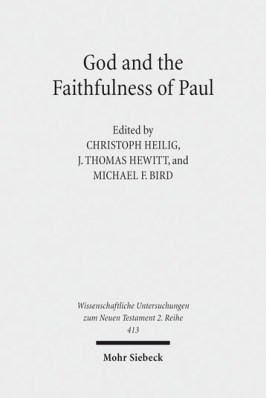
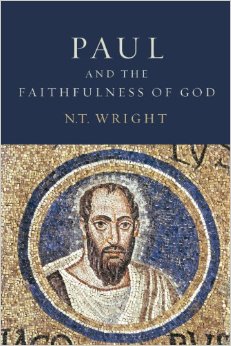
I am reading through God and the Faithfulness of Paul: A Critical Examination of the Pauline Theology of N.T. Wright (Mohr Siebeck 2016) and came across this surprising, and somewhat telling, quote from James D.G. Dunn (himself one of the major proponents of the “New Perspective on Paul”) regarding Wright’s big book Paul and the Faithfulness of God:

So what to make of Wright’s (final?) assessment of and contribution to “the new perspective on Paul?” The chief sense is one of disappointment that the new perspective proved to be not very important for him in his climactic treatment of Paul.

[quote from pg. 357]

It seems that, for Dunn at least, N.T. Wright is not “new perspective” enough!

Hmm…

An Easter Prayer by Karl Barth

Tags

, ,

karl barth

Here is an Easter prayer taken from Fifty Prayers by Karl Barth (Westminster John Knox Press 2008, kindle edition):

Lord God, our Father, you are the light in which there is no darkness. And now you have kindled in us a light that can never be extinguished and that will ultimately drive out all darkness. You are the love that knows no coldness. And now you have loved even us and freed us to love you and each other. You are the life that mocks death. And now you have given us access to this eternal life. You have done all this in Jesus Christ, your Son, our brother.

Do not let us – let none of us – remain dull and indifferent to your gift and revelation. Let us on this Easter morning see at least something of the riches of your goodness; let it enter into our hearts and minds, and let it enlighten us, uphold us, comfort us, and admonish us!

None of us is a great Christian; rather, we are all very small Christians. But your grace is sufficient for us. Awaken us to the small joy and thankfulness that we are capable of, the timid faith that we bring , the incomplete obedience that we cannot refuse – to the hope in greatness, wholeness, and completeness that you have prepared for us in the death of our Lord, Jesus Christ, and that you have promised us in his resurrection from the dead. We ask that this hour may serve that purpose. Amen.

Easter in the Belly of Nothingness

Tags

, , ,

Jesus' body

Here is a timely prayer by Walter Brueggemann from his book Prayers for a Privileged People (Abingdon Press 2008).

Easter in the Very Belly of Nothingness

Death will be all right for us when it comes. But dying is another matter — so slow, so painful, so humiliating.

Death will be a quick turn, the winking of an eye, but dying turns and twists and waits and teases.

We have not died, but we know about dying: We watch the inching pain of cancer, the oozing ache of alienation, the tears of stored up hurt.

We can smell the dying of bombs and shells,  of direct hit and collateral damage, of napalm spread thin and even of cities turned craters, of Agent Orange that waits years to show, and lives turned to empty stare.

We watch close or distant; we brace and stiffen, and grow cynical or uncaring.

And death wins — we, robbed of vitality, brought low by failed hope, lost innocence, emptied childhood, and stillness. 

We keep going, but barely; we gather at the grave, watching the sting and the victory of dread.

But you stir late Saturday; we gather early Sunday with balm and embracing, close to the body. waiting for the smell but not; dreading the withered site… but not; cringing love lost… but not here.

Not here… but risen, gone, awakened, alive!

The new creation stirs beyond the weeping women; O death… no sting! O grave… no victory! O silence… new song! O dread… new dance! O tribulation… now overcome!

O Friday God — Easter the failed city, Sunday the killing fields. And we, we shall dance and sing, thank and praise, into the night that holds no more darkness.


God and the Faithfulness of Paul

Tags

, ,

I just received my copy of God and the Faithfulness of Paul: A Critical Examination of the Pauline Theology of N.T. Wright, just released this month.

God and Faithfulness of Paul

Last summer I read N.T. Wright’s magnum opus, Paul and the Faithfulness of GodI can safely say that it was the longest book I have ever read, cover to cover, by far: a whopping 1,519 pages of text. It was a big deal. And I am glad that I did. Since the purpose of this post is not to review Wright’s PFG suffice it to say that it has changed the way I read Paul’s letters; indeed, I have learned an enormous amount about the significance of the entire story line of Scripture from Genesis to Revelation, creation to new creation. Wright’s work is stimulating and thought-provoking in a way that increases my love for Holy Scripture and continually forces me to return to the text.

Paul and the Faithfulness of God

Wright’s work on Paul was monumental. Now I am super excited to begin reading this examination of his work from a group of international scholars. As stated in the introduction (page 6):

[T]his volume is neither a Festschrift nor a refutation, but something entirely different. It is perhaps best described as a conversation among those involved in biblical and theological scholarship as to the positive achievements, potential failings, matters requiring clarification, and future questions that Wright’s PFG elicits for his scholarly peers.

Click the following link to see the table of contents: God-and-the-Faithfulness-of-Paul.

D. A. Carson on the Authority of Scripture

Tags

, ,

Here is a 17 minute interview with D. A. Carson on the new book he edited, The Enduring Authority of the Christian Scriptures (Eerdmans 2016). With an all-star evangelical line up it’s a mammoth of a book at over 1,200 pages long. There are 36 chapters covering topics in the areas of historical issues, biblical & theological issues, philisophical & epistemological issues, comparative religions issues, and even a chapter on FAQ’s! 


Here is a list of the contributing authors:

James Beilby
Kirsten Birkett
Henri A. G. Blocher
Craig L. Blomberg
D. A. Carson
Graham A. Cole
Stephen G. Dempster
Daniel M. Doriani
Simon Gathercole
David Gibson
Ida Glaser
Paul Helm
Charles E. Hill
Peter F. Jensen
Robert Kolb
Anthony N. S. Lane
Te-Li Lau
Richard Lints
V. Philips Long
Thomas H. McCall
Douglas J. Moo
Andrew David Naselli
Harold Netland
Osvaldo Padilla
Michael C. Rea
Bradley N. Seeman
Alex G. Smith
R. Scott Smith
Rodney L. Stiling
Glenn S. Sunshine
Timothy C. Tennent
Mark D. Thompson
Kevin J. Vanhoozer
Bruce K. Waltke
Barry G. Webb
Peter J. Williams
John D. Woodbridge

Video

Brant Pitre on Jesus & the Last Supper

Tags

, , ,

Brant Pitre is quickly becoming one of my favorite Catholic authors (along with Scott Hahn). Although I’ve only read two of Pitre’s books, they are both excellently written (the other one I’ve read is Jesus, the Tribulation, and the End of Exile: Restoration Eschatology and the Origin of the Atonement).

Here is a 24 minute interview with Pitre on his new book Jesus and the Last Supper:


Two new books by Stephen J. Wellum

Tags

, , , ,

In 2012, Stephen J. Wellum co-authored Kingdom Through Covenant: A Biblical-Theological Understanding of the Covenants along with Peter Gentry. It was received well, though not without making a few people uncomfortable from both covenant and dispensational camps. The work was a critique of both systems (with regard to weaknesses perceived by Gentry and Wellum), but also intended to provide a constructive way forward via biblical theology. Here is a 5 minute YouTube video of Gentry and Wellum discussing Kingdom Through Covenant.Progressive Covenantalism
In the same vein, Wellum is now releasing Progressive Covenantalism: Charting a Way Between Dispensational and Covenant Theologies (B&H Academic).  Preorder on Amazon here.

god the son incarnate (wellum)

On a different note (more a systematic theology genre than a biblical theology genre) Wellum is releasing God the Son Incarnate: The Doctrine of Christ (Crossway). This is his contribution in the Foundations of Evangelical Theology series (a great series!). Preorder on Amazon here.

St. Patrick, Apostle of Ireland

Tags

,

0317patrick-ireland

Today is St. Patrick’s Day, the day we remember the death of a slave turned missionary in the late 4th/early 5th century. Probably his most famous quote:

“Daily I expect murder, fraud or captivity, but I fear none of these things because of the promises of heaven. I have cast myself into the hands of God almighty who rules everywhere”


Some Academic Resources on St. Patrick:


Three Recent Articles

Tags

, , , , ,

Here are three recently published articles that are pretty good reading:

  • “Another look at πιστις Χριστου” by Morna D. Hooker, Scottish Journal of Theology 69 (1): 46-62 (2016).
  • “The Number of Variants in the Greek New Testament: A Proposed Estimate” by Peter J. Gurry, New Testament Studies 62: 97-121 (2016).
  • “‘O Taste and See’: Septuagint Psalm 33 in 1 Peter” by Karen H. Jobes, Stone-Campbell Journal 18: 241-251 (Fall, 2015).

Let’s go in reverse order.

First, “O Taste and See” is classic Karen Jobes. She is an accomplished evangelical scholar on 1 Peter, with a top rated commentary on this epistle (see here). The article here is an exercise in intertextual interpretation looking at Peter’s exhortation to crave pure, spiritual milk” (το λογικον αδολον γαλα επιποθησατε). Although sometimes understood as a reference to the word of God, Jobes rejects this reading. Instead by looking carefully at how Peter uses LXX Psalm 33 it makes better sense to see a reference to Christ himself as the pure, spiritual milk “which nurtures growth of spiritual life after rebirth into the new reality that Christ’s death, resurrection, and ascension has created…To crave the pure spiritual milk means to crave Christ himself, for only he can sustain the new life he created” (pgs. 249-250).

Second, Peter J. Gurry’s article on the number of textual variants in the GNT is a solidly researched article with an important find. Despite my hunch that there are probably only a small number of people interested in this type of research, it is nevertheless hugely important to get this kind of information correct. After a lengthy section discussing previous historical estimates, their problems, and his own methodology, Gurry proposes an estimate of about 500,000 variants (not including spelling differences). He only analyzes variants found in Greek manuscripts; that is, papyri, majuscules, minuscules and lectionaries, NOT versions, patristic citations, inscriptions, etc. (pg. 104). He defines a variant as “a word or concatenation of words in any manuscript that differs from any other manuscript within a comparable segment of text, excluding only spelling differences and different ways of abbreviating nomina sacra” (pg. 106). I will just add one more concluding thought on the value of the estimate:

“[O]ur estimate allows scholars to avoid passing the responsibility for their estimates to silent and invisible sources. The present estimate is based on a clear foundation in the available data and a clear method, both of which are open to public scrutiny. One hopes that these two qualities alone will be enough to discourage all of us from the continued rehashing of unverified and unverifiable information about the transmission of the Greek New Testament.” (pg. 118)

Third, “Another look at πιστις Χριστου” by Morna Hooker. The sheer amount of scholarly attention given to this phrase indicates the importance of it. Subjective genitive or objective genitive? Christ’s faith/faithfulness or our faith in Christ? In this paper, Hooker builds on her earlier work (‘Πιστις Χριστου’, New Testament Studies 35, 1989) by zeroing in on what exactly is meant by πιστις (pistis), particularly in some key texts in Romans. In doing so, she explores the relationship of human behavior and divine grace in the apostle Paul’s thought. She concludes by asking the question,

“So were Luther and his followers wrong? They were certainly not wrong to emphasize the role of faith. And as with the answers to our questions about other phrases we have briefly considered, it may well be that the answer to the question ‘Does this phrase refer to Christ’s faith or ours’? may be ‘Both’. Nevertheless, the faith/faithfulness is primarily that of Christ, and we share in it only because we are in him…In Christ, and through him, we are able to share his trust and obedience, and so become what God called his people to be.” (pg. 62)

NT Theology Bibliography

Tags

, ,

Christ the vine

Here are some of the most important works on New Testament Theology:

  • Adam, A. K. M. Making Sense of New Testament Theology: Modern Problems and Prospects. Eugene, Ore.: Wipf & Stock Pub, 2005.
  • Balla, Peter. Challenges to New Testament Theology: An Attempt to Justify the Enterprise. Grand Rapids, Mich.: Baker Academic, 1998.
  • Boers, Hendrikus. What Is New Testament Theology?: The Rise of Criticism and the Problem of a Theology of the New Testament. Philadelphia: Augsburg Fortress Publishing, 1975.
  • Breytenbach, Cilliers, and Jorg Frey, eds. Aufgabe Und Durchfuhrung Einer Theologie Des Neuen Testaments. Tübingen: Mohr Siebeck, 2007.
  • Caird, G.B. New Testament Theology. Oxford; Oxford; New York: Clarendon Press, 1995.
  • Conzelmann, Hans. An Outline of the Theology of the New Testament. Harper & Row, 1969.
  • Dodd, C. H. According to the Scriptures: The Sub-Structure of New Testament Theology. First Edition edition. Fontana, 1965.
  • Dunn, James D. G. New Testament Theology: An Introduction. Nashville, TN: Abingdon Press, 2009.
  • Esler, Philip Francis. New Testament Theology: Communion and Community. Fortress Press, 2009.
  • Matera, Frank J. New Testament Theology: Exploring Diversity and Unity. Louisville, Ky: Westminster John Knox Press, 2007.
  • Morgan, Robert. The Nature of New Testament Theology. London: Hymns Ancient & Modern Ltd, 2012.
  • ———. The Nature of New Testament Theology: The Contribution of William Wrede and Adolf Schlatter,. Naperville, Ill: A. R. Allenson, 1973.
  • Osborne, Grant, and Ray Van Neste. New Testament Theology in Light of the Churchs Mission: Essays in Honor of I. Howard Marshall. Edited by Jon C. Laansma. Eugene, Or: Wipf & Stock Pub, 2011.
  • Raisanen, Heikki. Beyond New Testament Theology. 2 edition. London: Hymns Ancient & Modern Ltd, 2000.
  • Rowland, Christopher, and Christopher Tuckett, eds. The Nature of New Testament Theology: Essays in Honour of Robert Morgan. 1 edition. Malden, MA: Wiley-Blackwell, 2006.
  • Schlatter, Adolf. The History of the Christ: The Foundation of New Testament Theology. Grand Rapids, Mich: Baker Academic, 1997.
  • ———. The Theology of the Apostles: The Development of New Testament Theology. 2 edition. Grand Rapids, Mich: Baker Academic, 1999.
  • Schnelle, Udo. Theology of the New Testament. Translated by M. Eugene Boring. Grand Rapids, Mich: Baker Academic, 2009.
  • Schreiner, Thomas R. New Testament Theology: Magnifying God in Christ. Grand Rapids, Mich: Baker Academic, 2008.
  • Via, Dan O. What Is New Testament Theology? Fortress Press, 2002.
  • Weiss, Bernhard, David Eaton, and James E. Duguid. Biblical Theology of the New Testament. BiblioBazaar, 2009.
  • Whitlark, Jason, Bruce Longenecker, Lidija Novakovic, and Mikeal Parsons, eds. Interpretation and the Claims of the Text: Resourcing New Testament Theology. Waco, Texas: Baylor University Press, 2014.