• Home
  • About
  • Resources

The Cruciform Pen

~ toward a cross-shaped life

The Cruciform Pen

Category Archives: People to Know

Longenecker’s Commentary on Romans

02 Monday May 2016

Posted by thecruciformpen in People to Know, Resources, Reviews

≈ Leave a comment

Tags

Commentaries, Paul's Epistles, Richard N. Longenecker, Romans

longenecker romans

Richard N. Longenecker recently released his new commentary on Romans in the NIGTC series. I got my copy in the mail not too long ago and have been slowly working through it (it’s a mammoth 1,086 pages of commentary!). Below I list some of my own observations by way of a quick critical review.

There is virtual consensus among Pauline scholars that Romans is structured with four clearly distinguishable sections: chs. 1-4, chs. 5-8, chs. 9-11, chs. 12-16. Further, commentators will typically emphasize one particular section as being the heart of Romans. Sometimes, but not always, the emphasis given to a particular section is correlate with that commentator’s theological persuasions; e.g., those who understand justification in juridical terms will focus on Rom 1-4, those who focus more on participationist categories will look to Rom 5-8, etc. While Longenecker certainly doesn’t ignore the juridical category, he does understand chs. 5-8 to be the essence, and primary thrust, of Romans. This preference is reflected in statements like the following (pg. 566):

What he appears to be doing in 5:9-11 is attempting to convince his addressees that there is much more to to the Christian gospel than simply the forensic doctrine of justification ‘by the blood of Christ'(εν τω αιματι αυτου) or ‘through the death of God’s Son’ (δια του θανατου του υιου αυτου) — as important as that emphasis is in Christian proclamation. What also needs to be considered and experienced is what Christ has effected on behalf of those who respond to him by faith in terms of the ‘personal,’ ‘relational,’ and ‘participatory’ theme of reconciliation. 

Longenecker’s primary dialogue partners are C.K. Barret, C.E.B Cranfield, James D. G. Dunn, Joseph A. Fitzmyer, Robert Jewett, Ernst Käsemann, Douglas J. Moo, Arthur C. Headlam, and William Sanday. It is true that, even for a commentary over a thousand pages, one has to be selective about who to engage with while interpreting particular texts. Nevertheless, I was quite surprised that N.T. Wright’s commentary on Romans (NIB series vol. 10) did not even make it into the bibliography! It would’ve been interesting to see more dialogue between the two. 

On the other hand, Longenecker shows an impressive familiarity with ancient sources. He regularly interacts with writings from the Pseudepigrapha, Dead Sea Scrolls, early Christian writings, as well as Classical / Hellenistic sources. His textual criticism is thorough, often giving several pages of discussion to variants and the respective mss. involved. It appears that he relies primarily on Bruce Metzger’s Textual Commentary on the Greek New Testament for text critical dialogue, though Longenecker is by no means dependent on Metzger for his conclusions (e.g., Rom 5:1, Longnecker reads the subjunctive εχωμεν as original contra. Metzger who takes Paul to have dictated εχομεν for which Tertius wrote εχωμεν). 

Unlike some commentaries which seem to comment more on previous commentaries, Longenecker strikes an even balance between engagement with previous interpreters and the text of Romans itself. (This despite my personal judgement that engagement with some important contemporary interpreters were often left out of his discussions at key points)

His sections throughout on Biblical Theology and Contextualization for Today were sometimes helpful and sometimes confusing. It may have proved helpful to have an explanation on how he intended these sections to function within the structure of his commentary. At times they were combined into a single section under one heading. 

Now some grist for the mill…

 Regarding the background of ευαγγελιον in 1:1, Longenecker, following Käsemann and Stuhlmacher, rejects any counterimperial resonances in the word (see pgs. 58-61). 

Contrast N.T. Wright who, while not denying the primary significance of the OT for understanding the word, sees a counterimperial resonance as unavoidable for believers living in the heart of the Roman Empire: 

In Paul’s Jewish world, the word looked back to Isa 40:9 and 52:7, where a messenger was to bring to Jerusalem the good news of Babylon’s defeat, the end of Israel’s exile, and the personal return of YHWH to Zion. In the pagan world Paul addressed, the same Greek word referred to the announcement of the accession or the birthday of a ruler or emperor. Here already we find Paul at the interface of his two worlds. His message about Jesus was both the fulfillment of prophecy, as v. 2 indicates, and the announcement of one whose rule posed a challenge to all other rulers. 

[Wright, Romans, 415-416]

I can’t imagine Paul being ignorant about the possibility of his readers (or listeners) in Rome thinking of both Isaiah’s ευαγγελιον and also Caesar’s ευαγγελιον. Therefore, in this instance I find Wright’s position more appealing. 

Longenecker has the following excurses (although they are unhelpfully absent from the Table of Contents and Index): 

  • “The Righteousness of God” and “Righteousness” in Paul (168-176)

  • Three exegetical and thematic matters in Rom 3:25a that are of particular importance (though also frequently disputed) and therefore deserving of special consideration (425-432)

  • “The law,” “Works of the law,” and “The New Prespective” (362-370)

  • Paul’s message of reconciliation (566-570)  

  • Paul’s use of “In Christ Jesus” and its Cognates (686-694)

  • On the terms for “Remnant” in the OT Scriptures (MT and LXX), as well as the use of “Remnant” in the Rabbinic tractates of formative Judaism and the Jewish nonconformist writings of the first centuries B.C. (803-810) 

In sum, Longenecker has given us an excellent commentary, though not without some quibbles. He is an accomplished scholar who has given us much to think about for Romans. This is not just a rehearsal of previous positions on old debates. Longenecker often has creative new solutions of his own, even if not always convincing. Even in areas where I found myself disagreeing with his conclusions he always gives excellent material to work with (or to disagree with). He is a clear writer. This commentary will certainly be one of the first Romans commentaries I pull of the shelf when in need. 
Dunn Thinks Wright’s PFG is Too Little Aligned with the New Perspective on Paul

28 Monday Mar 2016

Posted by thecruciformpen in People to Know, Resources, Reviews

≈ Leave a comment

Tags

James D.G. Dunn, N. T. Wright, New Perspective on Paul

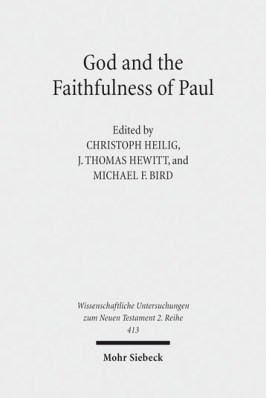
I am reading through God and the Faithfulness of Paul: A Critical Examination of the Pauline Theology of N.T. Wright (Mohr Siebeck 2016) and came across this surprising, and somewhat telling, quote from James D.G. Dunn (himself one of the major proponents of the “New Perspective on Paul”) regarding Wright’s big book Paul and the Faithfulness of God:

So what to make of Wright’s (final?) assessment of and contribution to “the new perspective on Paul?” The chief sense is one of disappointment that the new perspective proved to be not very important for him in his climactic treatment of Paul.

[quote from pg. 357]

It seems that, for Dunn at least, N.T. Wright is not “new perspective” enough!

Hmm…

God and the Faithfulness of Paul

25 Friday Mar 2016

Posted by thecruciformpen in People to Know, Resources, Reviews

≈ Leave a comment

Tags

N. T. Wright, Paul's Epistles, Pauline Theology

I just received my copy of God and the Faithfulness of Paul: A Critical Examination of the Pauline Theology of N.T. Wright, just released this month.

God and Faithfulness of Paul

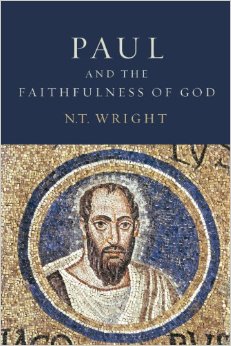
Last summer I read N.T. Wright’s magnum opus, Paul and the Faithfulness of God. I can safely say that it was the longest book I have ever read, cover to cover, by far: a whopping 1,519 pages of text. It was a big deal. And I am glad that I did. Since the purpose of this post is not to review Wright’s PFG suffice it to say that it has changed the way I read Paul’s letters; indeed, I have learned an enormous amount about the significance of the entire story line of Scripture from Genesis to Revelation, creation to new creation. Wright’s work is stimulating and thought-provoking in a way that increases my love for Holy Scripture and continually forces me to return to the text.

Paul and the Faithfulness of God

Wright’s work on Paul was monumental. Now I am super excited to begin reading this examination of his work from a group of international scholars. As stated in the introduction (page 6):

[T]his volume is neither a Festschrift nor a refutation, but something entirely different. It is perhaps best described as a conversation among those involved in biblical and theological scholarship as to the positive achievements, potential failings, matters requiring clarification, and future questions that Wright’s PFG elicits for his scholarly peers.

Click the following link to see the table of contents: God-and-the-Faithfulness-of-Paul.

D. A. Carson on the Authority of Scripture

21 Monday Mar 2016

Posted by thecruciformpen in People to Know, Resources

≈ Leave a comment

Tags

D. A. Carson, Interview, Scripture and Authority

Here is a 17 minute interview with D. A. Carson on the new book he edited, The Enduring Authority of the Christian Scriptures (Eerdmans 2016). With an all-star evangelical line up it’s a mammoth of a book at over 1,200 pages long. There are 36 chapters covering topics in the areas of historical issues, biblical & theological issues, philisophical & epistemological issues, comparative religions issues, and even a chapter on FAQ’s! 


Here is a list of the contributing authors:

James Beilby
Kirsten Birkett
Henri A. G. Blocher
Craig L. Blomberg
D. A. Carson
Graham A. Cole
Stephen G. Dempster
Daniel M. Doriani
Simon Gathercole
David Gibson
Ida Glaser
Paul Helm
Charles E. Hill
Peter F. Jensen
Robert Kolb
Anthony N. S. Lane
Te-Li Lau
Richard Lints
V. Philips Long
Thomas H. McCall
Douglas J. Moo
Andrew David Naselli
Harold Netland
Osvaldo Padilla
Michael C. Rea
Bradley N. Seeman
Alex G. Smith
R. Scott Smith
Rodney L. Stiling
Glenn S. Sunshine
Timothy C. Tennent
Mark D. Thompson
Kevin J. Vanhoozer
Bruce K. Waltke
Barry G. Webb
Peter J. Williams
John D. Woodbridge

Video

Brant Pitre on Jesus & the Last Supper

20 Sunday Mar 2016

Posted by thecruciformpen in Biblical Studies, People to Know, Resources

≈ Leave a comment

Tags

Brant Pitre, Interview, Jesus, The Last Supper

Brant Pitre is quickly becoming one of my favorite Catholic authors (along with Scott Hahn). Although I’ve only read two of Pitre’s books, they are both excellently written (the other one I’ve read is Jesus, the Tribulation, and the End of Exile: Restoration Eschatology and the Origin of the Atonement).

Here is a 24 minute interview with Pitre on his new book Jesus and the Last Supper:


Two new books by Stephen J. Wellum

18 Friday Mar 2016

Posted by thecruciformpen in Biblical Studies, People to Know, Resources

≈ 1 Comment

Tags

Christology, Covenant Theology, Dispensationalism, Progressive Covenantalism, Stephen J. Wellum

In 2012, Stephen J. Wellum co-authored Kingdom Through Covenant: A Biblical-Theological Understanding of the Covenants along with Peter Gentry. It was received well, though not without making a few people uncomfortable from both covenant and dispensational camps. The work was a critique of both systems (with regard to weaknesses perceived by Gentry and Wellum), but also intended to provide a constructive way forward via biblical theology. Here is a 5 minute YouTube video of Gentry and Wellum discussing Kingdom Through Covenant.Progressive Covenantalism
In the same vein, Wellum is now releasing Progressive Covenantalism: Charting a Way Between Dispensational and Covenant Theologies (B&H Academic).  Preorder on Amazon here.

god the son incarnate (wellum)

On a different note (more a systematic theology genre than a biblical theology genre) Wellum is releasing God the Son Incarnate: The Doctrine of Christ (Crossway). This is his contribution in the Foundations of Evangelical Theology series (a great series!). Preorder on Amazon here.

St. Patrick, Apostle of Ireland

17 Thursday Mar 2016

Posted by thecruciformpen in Historical Studies, People to Know, Resources

≈ Leave a comment

Tags

Apostle of Ireland, St. Patrick

0317patrick-ireland

Today is St. Patrick’s Day, the day we remember the death of a slave turned missionary in the late 4th/early 5th century. Probably his most famous quote:

“Daily I expect murder, fraud or captivity, but I fear none of these things because of the promises of heaven. I have cast myself into the hands of God almighty who rules everywhere”


Some Academic Resources on St. Patrick:

  • The Book of Letters of Saint Patrick the Bishop by D. R. Howlett 
  • The Life and Legend of St. Patrick: Problems of Modern Scholarship by Ludwig Bieler (1949)
  • The Problem of St. Patrick by James Carney (1973)
  • Saint Patrick: His Origins and Career by R.P.C. Hanson (1997)
  • Saint Patrick A.D. 493-1993 by D. N. Dumville (1993)


Three Recent Articles

05 Saturday Mar 2016

Posted by thecruciformpen in People to Know, Resources, Reviews

≈ Leave a comment

Tags

Intertextuality, Pauline Theology, Peter, Psalms, review, Textual Criticism

Here are three recently published articles that are pretty good reading:

  • “Another look at πιστις Χριστου” by Morna D. Hooker, Scottish Journal of Theology 69 (1): 46-62 (2016).
  • “The Number of Variants in the Greek New Testament: A Proposed Estimate” by Peter J. Gurry, New Testament Studies 62: 97-121 (2016).
  • “‘O Taste and See’: Septuagint Psalm 33 in 1 Peter” by Karen H. Jobes, Stone-Campbell Journal 18: 241-251 (Fall, 2015).

Let’s go in reverse order.

First, “O Taste and See” is classic Karen Jobes. She is an accomplished evangelical scholar on 1 Peter, with a top rated commentary on this epistle (see here). The article here is an exercise in intertextual interpretation looking at Peter’s exhortation to “crave pure, spiritual milk” (το λογικον αδολον γαλα επιποθησατε). Although sometimes understood as a reference to the word of God, Jobes rejects this reading. Instead by looking carefully at how Peter uses LXX Psalm 33 it makes better sense to see a reference to Christ himself as the pure, spiritual milk “which nurtures growth of spiritual life after rebirth into the new reality that Christ’s death, resurrection, and ascension has created…To crave the pure spiritual milk means to crave Christ himself, for only he can sustain the new life he created” (pgs. 249-250).

Second, Peter J. Gurry’s article on the number of textual variants in the GNT is a solidly researched article with an important find. Despite my hunch that there are probably only a small number of people interested in this type of research, it is nevertheless hugely important to get this kind of information correct. After a lengthy section discussing previous historical estimates, their problems, and his own methodology, Gurry proposes an estimate of about 500,000 variants (not including spelling differences). He only analyzes variants found in Greek manuscripts; that is, papyri, majuscules, minuscules and lectionaries, NOT versions, patristic citations, inscriptions, etc. (pg. 104). He defines a variant as “a word or concatenation of words in any manuscript that differs from any other manuscript within a comparable segment of text, excluding only spelling differences and different ways of abbreviating nomina sacra” (pg. 106). I will just add one more concluding thought on the value of the estimate:

“[O]ur estimate allows scholars to avoid passing the responsibility for their estimates to silent and invisible sources. The present estimate is based on a clear foundation in the available data and a clear method, both of which are open to public scrutiny. One hopes that these two qualities alone will be enough to discourage all of us from the continued rehashing of unverified and unverifiable information about the transmission of the Greek New Testament.” (pg. 118)

Third, “Another look at πιστις Χριστου” by Morna Hooker. The sheer amount of scholarly attention given to this phrase indicates the importance of it. Subjective genitive or objective genitive? Christ’s faith/faithfulness or our faith in Christ? In this paper, Hooker builds on her earlier work (‘Πιστις Χριστου’, New Testament Studies 35, 1989) by zeroing in on what exactly is meant by πιστις (pistis), particularly in some key texts in Romans. In doing so, she explores the relationship of human behavior and divine grace in the apostle Paul’s thought. She concludes by asking the question,

“So were Luther and his followers wrong? They were certainly not wrong to emphasize the role of faith. And as with the answers to our questions about other phrases we have briefly considered, it may well be that the answer to the question ‘Does this phrase refer to Christ’s faith or ours’? may be ‘Both’. Nevertheless, the faith/faithfulness is primarily that of Christ, and we share in it only because we are in him…In Christ, and through him, we are able to share his trust and obedience, and so become what God called his people to be.” (pg. 62)

NT Theology Bibliography

12 Friday Feb 2016

Posted by thecruciformpen in People to Know, Resources

≈ Leave a comment

Tags

Biblical Theology, Bibliography, NT Theology

Christ the vine

Here are some of the most important works on New Testament Theology:

  • Adam, A. K. M. Making Sense of New Testament Theology: Modern Problems and Prospects. Eugene, Ore.: Wipf & Stock Pub, 2005.
  • Balla, Peter. Challenges to New Testament Theology: An Attempt to Justify the Enterprise. Grand Rapids, Mich.: Baker Academic, 1998.
  • Boers, Hendrikus. What Is New Testament Theology?: The Rise of Criticism and the Problem of a Theology of the New Testament. Philadelphia: Augsburg Fortress Publishing, 1975.
  • Breytenbach, Cilliers, and Jorg Frey, eds. Aufgabe Und Durchfuhrung Einer Theologie Des Neuen Testaments. Tübingen: Mohr Siebeck, 2007.
  • Caird, G.B. New Testament Theology. Oxford; Oxford; New York: Clarendon Press, 1995.
  • Conzelmann, Hans. An Outline of the Theology of the New Testament. Harper & Row, 1969.
  • Dodd, C. H. According to the Scriptures: The Sub-Structure of New Testament Theology. First Edition edition. Fontana, 1965.
  • Dunn, James D. G. New Testament Theology: An Introduction. Nashville, TN: Abingdon Press, 2009.
  • Esler, Philip Francis. New Testament Theology: Communion and Community. Fortress Press, 2009.
  • Matera, Frank J. New Testament Theology: Exploring Diversity and Unity. Louisville, Ky: Westminster John Knox Press, 2007.
  • Morgan, Robert. The Nature of New Testament Theology. London: Hymns Ancient & Modern Ltd, 2012.
  • ———. The Nature of New Testament Theology: The Contribution of William Wrede and Adolf Schlatter,. Naperville, Ill: A. R. Allenson, 1973.
  • Osborne, Grant, and Ray Van Neste. New Testament Theology in Light of the Churchs Mission: Essays in Honor of I. Howard Marshall. Edited by Jon C. Laansma. Eugene, Or: Wipf & Stock Pub, 2011.
  • Raisanen, Heikki. Beyond New Testament Theology. 2 edition. London: Hymns Ancient & Modern Ltd, 2000.
  • Rowland, Christopher, and Christopher Tuckett, eds. The Nature of New Testament Theology: Essays in Honour of Robert Morgan. 1 edition. Malden, MA: Wiley-Blackwell, 2006.
  • Schlatter, Adolf. The History of the Christ: The Foundation of New Testament Theology. Grand Rapids, Mich: Baker Academic, 1997.
  • ———. The Theology of the Apostles: The Development of New Testament Theology. 2 edition. Grand Rapids, Mich: Baker Academic, 1999.
  • Schnelle, Udo. Theology of the New Testament. Translated by M. Eugene Boring. Grand Rapids, Mich: Baker Academic, 2009.
  • Schreiner, Thomas R. New Testament Theology: Magnifying God in Christ. Grand Rapids, Mich: Baker Academic, 2008.
  • Via, Dan O. What Is New Testament Theology? Fortress Press, 2002.
  • Weiss, Bernhard, David Eaton, and James E. Duguid. Biblical Theology of the New Testament. BiblioBazaar, 2009.
  • Whitlark, Jason, Bruce Longenecker, Lidija Novakovic, and Mikeal Parsons, eds. Interpretation and the Claims of the Text: Resourcing New Testament Theology. Waco, Texas: Baylor University Press, 2014.

The “Glory of God” in Romans

15 Friday Jan 2016

Posted by thecruciformpen in Biblical Studies, People to Know, Reviews

≈ Leave a comment

Tags

Apocalyptic Interpretation, Beverly Gaventa, Glory of God, Pauline Theology, Romans

Interpretation and the Claims of the TextI recently read a fascinating chapter by Beverly Gaventa on “The ‘Glory of God’ in Paul’s Letter to the Romans”. Gaventa contributed this chapter in the book Interpretation & the Claims of the Text: Resourcing New Testament Theology (Baylor University Press, 2014), a collection of essays in honor of Charles Talbert.

On the premise that relatively little scholarly work has been done on the phrase “the glory of God” (δοξα του θεου) in Paul’s letters Gaventa sets out to demonstrate three things (pg.29):

  1. That “glory of God” is an important motif in Romans
  2.  That it draws on earlier Jewish associations connecting God’s glory with God’s salvific presence
  3. That it plays a role in Paul’s apocalyptic interpretation of the gospel

In her survey of glory of God language in Romans, Gaventa highlights two particularly disputed passages: Romans 3.23 and 5.2.

With regard to Romans 3.23 Gaventa makes two moves. Firstly, she suggests that it should be translated (following Leander Keck and also The New American Bible) as follows: “all are deprived of the glory of God”. This brings our the passive voice of the verb (contra. the more common renderings “lack” or “fall short of”). Secondly, she draws attention to what exactly is meant by “glory of God” in the claim that humanity is deprived of it. She concludes that Paul “refers not to humanity’s own original state of glory but to the loss of its proper, worshipful relationship to God” (pg.31). As a side note, the Good News Translation of the Bible supports Gaventa’s reading of the glory-of-God language in this verse: “everyone has sinned and is far away from God’s saving presence” (Rom 3.23 GNB).

In regard to Romans 5.2, the phrase is usually read as hope for humanity’s own eschatological glory. Gaventa suggests rather that to hope in the glory of God means to expect God’s triumphant presence.

This leads into her discussion of how the Old Testament and other Jewish literature uses glory-of-God language to refer to God’s own presence (e.g. inter alia Ex 24.16; 40.34; Lev 9.23; Ps 56.6; Ezek 11.23). But she points out that in many places it is not just a general presence that is signified by the phrase “it is God’s presence as that presence powerfully triumphs over God’s intractable enemies” (pg.33, emphasis added). In other words, “God’s δοξα is not just God’s presence, but God’s presence for the purpose of an eschatological establishment of God’s saving kingdom” (pg.34).

This claim is supported by a survey of the ubiquitous, but little noticed, conflict language throughout Romans. Again, she concludes that “the ‘glory of God’ signals not only God’s own presence but something more — God’s presence as it triumphs over God’s own enemies, most especially the enemies named Sin and Death” (pg.36).

Among other ramifications of this reading for understanding Paul is that the resurrection of Jesus from the dead is not primarily a proof of his divinity or his identity as the messiah (although it is that, to be sure), but instead the “beginning of God’s triumph. That is why Paul can go on to say in Romans 6.9-10 that Death and Sin no longer rule over Christ; they have been defeated by the “glory of the father” (pg.36).

More could be said but I will stop here. Gaventa has certainly given us something to consider which has profound implications for how we understand a concept as important as the glory of God. As always her work is thought provoking and well worth the reading.

Soli Deo gloria.

← Older posts
Newer posts →

Categories

  • Biblical Studies (20)
  • Historical Studies (12)
  • People to Know (27)
  • Poetry (2)
  • Prayers (7)
  • Research Topics / Book Ideas (3)
  • Resources (52)
  • Reviews (24)

Posts

  • February 2023 (1)
  • September 2022 (1)
  • October 2020 (1)
  • February 2020 (1)
  • December 2019 (1)
  • August 2019 (1)
  • February 2019 (3)
  • December 2018 (1)
  • June 2018 (1)
  • May 2018 (2)
  • March 2018 (6)
  • January 2018 (1)
  • November 2017 (1)
  • October 2017 (1)
  • May 2016 (4)
  • April 2016 (3)
  • March 2016 (10)
  • February 2016 (1)
  • January 2016 (4)
  • December 2015 (5)
  • October 2015 (1)
  • September 2015 (6)
  • February 2015 (1)
  • January 2015 (6)
  • December 2014 (12)
  • November 2014 (8)
  • October 2014 (1)

Enter your email address to follow this blog and receive notifications of new posts by email.

Join 46 other subscribers

Currently Reading

Blogs I Follow

  • Malcolm Guite
  • The Cruciform Pen
  • βιβλιοσκώληξ
  • Holy Writ & Sacred Witness
  • Griffin Paul Jackson
  • Koine-Greek
  • Biblical Studies
  • Bible Design Blog
  • Theological Studies
  • καὶ τὰ λοιπά
  • Euangelion
  • Evangelical Textual Criticism
  • NT Blog

Blog at WordPress.com.

Malcolm Guite

Blog for poet and singer-songwriter Malcolm Guite

The Cruciform Pen

toward a cross-shaped life

βιβλιοσκώληξ

βιβλιο: "book"; σκώληξ: "worm"

Holy Writ & Sacred Witness

...eyes on the Word; ears to the ground...

Griffin Paul Jackson

Word architect.

Koine-Greek

Studies in Greek Language & Linguistics

Biblical Studies

Bible Design Blog

Theological Studies

An Internet Resource for Studying Christian Theology

καὶ τὰ λοιπά

A blog by Daniel R. Streett all about Early Judaism, Biblical Studies, Koine Greek, καὶ τὰ λοιπά

Euangelion

toward a cross-shaped life

Evangelical Textual Criticism

toward a cross-shaped life

NT Blog

toward a cross-shaped life

  • Subscribe Subscribed
    • The Cruciform Pen
    • Join 46 other subscribers
    • Already have a WordPress.com account? Log in now.
    • The Cruciform Pen
    • Subscribe Subscribed
    • Sign up
    • Log in
    • Report this content
    • View site in Reader
    • Manage subscriptions
    • Collapse this bar
 

Loading Comments...