• Home
  • About
  • Resources

The Cruciform Pen

~ toward a cross-shaped life

The Cruciform Pen

Category Archives: Resources

NT Theology Bibliography

12 Friday Feb 2016

Posted by thecruciformpen in People to Know, Resources

≈ Leave a comment

Tags

Biblical Theology, Bibliography, NT Theology

Christ the vine

Here are some of the most important works on New Testament Theology:

  • Adam, A. K. M. Making Sense of New Testament Theology: Modern Problems and Prospects. Eugene, Ore.: Wipf & Stock Pub, 2005.
  • Balla, Peter. Challenges to New Testament Theology: An Attempt to Justify the Enterprise. Grand Rapids, Mich.: Baker Academic, 1998.
  • Boers, Hendrikus. What Is New Testament Theology?: The Rise of Criticism and the Problem of a Theology of the New Testament. Philadelphia: Augsburg Fortress Publishing, 1975.
  • Breytenbach, Cilliers, and Jorg Frey, eds. Aufgabe Und Durchfuhrung Einer Theologie Des Neuen Testaments. Tübingen: Mohr Siebeck, 2007.
  • Caird, G.B. New Testament Theology. Oxford; Oxford; New York: Clarendon Press, 1995.
  • Conzelmann, Hans. An Outline of the Theology of the New Testament. Harper & Row, 1969.
  • Dodd, C. H. According to the Scriptures: The Sub-Structure of New Testament Theology. First Edition edition. Fontana, 1965.
  • Dunn, James D. G. New Testament Theology: An Introduction. Nashville, TN: Abingdon Press, 2009.
  • Esler, Philip Francis. New Testament Theology: Communion and Community. Fortress Press, 2009.
  • Matera, Frank J. New Testament Theology: Exploring Diversity and Unity. Louisville, Ky: Westminster John Knox Press, 2007.
  • Morgan, Robert. The Nature of New Testament Theology. London: Hymns Ancient & Modern Ltd, 2012.
  • ———. The Nature of New Testament Theology: The Contribution of William Wrede and Adolf Schlatter,. Naperville, Ill: A. R. Allenson, 1973.
  • Osborne, Grant, and Ray Van Neste. New Testament Theology in Light of the Churchs Mission: Essays in Honor of I. Howard Marshall. Edited by Jon C. Laansma. Eugene, Or: Wipf & Stock Pub, 2011.
  • Raisanen, Heikki. Beyond New Testament Theology. 2 edition. London: Hymns Ancient & Modern Ltd, 2000.
  • Rowland, Christopher, and Christopher Tuckett, eds. The Nature of New Testament Theology: Essays in Honour of Robert Morgan. 1 edition. Malden, MA: Wiley-Blackwell, 2006.
  • Schlatter, Adolf. The History of the Christ: The Foundation of New Testament Theology. Grand Rapids, Mich: Baker Academic, 1997.
  • ———. The Theology of the Apostles: The Development of New Testament Theology. 2 edition. Grand Rapids, Mich: Baker Academic, 1999.
  • Schnelle, Udo. Theology of the New Testament. Translated by M. Eugene Boring. Grand Rapids, Mich: Baker Academic, 2009.
  • Schreiner, Thomas R. New Testament Theology: Magnifying God in Christ. Grand Rapids, Mich: Baker Academic, 2008.
  • Via, Dan O. What Is New Testament Theology? Fortress Press, 2002.
  • Weiss, Bernhard, David Eaton, and James E. Duguid. Biblical Theology of the New Testament. BiblioBazaar, 2009.
  • Whitlark, Jason, Bruce Longenecker, Lidija Novakovic, and Mikeal Parsons, eds. Interpretation and the Claims of the Text: Resourcing New Testament Theology. Waco, Texas: Baylor University Press, 2014.

A Narrative Model for Active Reading

18 Monday Jan 2016

Posted by thecruciformpen in Biblical Studies, Resources, Reviews

≈ Leave a comment

Tags

Gospels, Jonathan Pennington, Narrative

penningtonJonathan Pennington, in Reading the Gospels Wisely: A Narrative and Theological Introduction, offers the following strategy for actively reading the Gospel narratives. He introduces his model by contrasting it with another common study method he calls the “Whatever Strikes Me” model (pg.171):
For many readers of narrative the meaning one comes away with is usually based on what we may call the “WSM Hermeneutic”–“Whatever Strikes Me.” That is, most readers–whether brand-new to the Gospels or lifelong readers–simply read the stories and take away from them whatever comes to mind, whatever stands out to them this time. At times this approach will be sufficient, thanks either to luck or to the intuitions of a generally skilled reader. But overall, for wise reading we need a more solid understanding of how stories work–how they speak and communicate–so that we can learn to read the Gospel narratives well and to adjudicate wisely among various good readings. We need a model for narrative analysis.


(for the following strategy see pgs.175-176; and esp. pgs. 202-203):

  • Isolate the Literary Unit

First, we need to determine the parameters of the story. What is the proper demarcation of the episode? Usually in the Gospels this will be clearly indicated by the paragraph breaks given in our Bibles.

  • Read the Story Multiple Times

We must keep the whole experience of the story at the forefront rather simply jumping right into analysis. Read it slowly. Read in quickly. Read it silently. Read it aloud. (If you can read it in Greek, all the better!)

  • Identify the Setting and the Characters

It is helpful to simply state what the setting is and to list all the characters. Who is here and where is this story happening?

  • Observe the Story

Are there key words or phrases or repeated ideas? Are cause-and-effect relationships stated? What illustrations are used , if any?Noting all these things will help you pay closer attention to the story. Ask questions of the text and write them down. Explore the text with an open mind. There are no stupid questions or observations!

  • Isolate the Different Scenes

At this stage it is helpful to take the whole pericope and simply break it up into different scenes (note above comments). The first scene will usually be the setting.

  • Analyze the Narrative:
    • Identify the Rising Tension
    • Identify the Climax
    • Identify the Resolution
    • Identify the Following Action/Interpretation
  • Think About the Contexts
    • Acts, Cycles, and Literary Structures
      • An act consists of several sequentially related stories together, and a cycle, a number of acts strung together. For example, the three lost/found parables in Luke 15 are all meant to be read as a unit (an act), and likewise Jesus’ journey to Jerusalem in Luke 9:51-19:27 is one large section (a cycle) with many acts within it (pg .186).
      • Sometimes several episodes are combined into literary structures in such a way that creates a greater meaning being communicated than individual episodes can give by themselves. A literary structure may be discerned when a series of episodes itself has a point and theme that goes beyond any individual pericope (pgs. 186-189). Pennington perceptively discerns a literary structure in Matthew 21-23 focused on Jesus as the son of David and the rejection of the Jewish leadership in Jerusalem.
    • The Whole Gospel Context Including Intratextuality, the Fourfold Gospel Book, and Jesus’ Death and Resurrection
      • Intratextuality = allusions to any particular story elsewhere in the same Gospel, thereby indicating that we should read these accounts in light of each other (pg.189). Pennington gives the following as some examples: Jesus’ predictions of his own impending death and resurrection, and also the appellation “king of the Jews” in the early chapters of Matthew in reference to Jesus instead of Herod.
      • Fourfold Gospel Book = Since what we are given in the Holy Gospels is not just individual stories or even individual books but rather a fourfold book, the best readings of any episode take into account relevant information from the rest of the Gospels canon. A good synopsis is valuable for this. By noting the similarities and differences between how the four evangelists tell their stories we can gain insight into how that particular evangelist develops his plot and motifs (pg. 192). To use a phrase that Abraham Kuruvilla uses often, “What is the author doing with what he is saying?”
      • Jesus’ Death and Resurrection = the focal point of the entire Gospel narratives (as indicated by the relative space given to the events surrounding Jesus’ final week). This means that any individual episode, act, or cycle must be read in the light of Jesus’ passion in order to understand it’s full significance. The sermon on the mount is given as an example of a unit whose full significance only comes to light after Jesus’ passion (pg. 195).
    • The Kingdom-Focused, Redemptive-Historical Context of the whole Canon
      • When we read the Gospels in light of the entire canon, we see that even the elaborate and complex stories of the Gospels do not exist in a vacuum but are clearly situated as part of the larger story of the whole Bible (pg.198).
  • Summarize the Pericope
    • This final step in the narrative model for active reading is important for forcing us to articulate what is most significant in a particular story. When writing the summary be sensitive to the narrative flow, characterization, and the various contexts as they affect its meaning (pg. 203).


Commentary Sale!

05 Tuesday Jan 2016

Posted by thecruciformpen in Resources

≈ Leave a comment

Tags

Commentaries, Sale

There are two commentary series on sale right now at Logos Bible Software:

  1. NIV Application Commentary (NIVAC)
  2. Understanding the Bible (UBOT / UBNT)

The NIV Application Commentary series is on sale for $7.99 each (that’s on average 65% off original price). Just use this Promo Code: NIVAC16

I recommend getting the following volumes from this series:

  • Exodus by Peter Enns
  • Esther by Karen Jobes
  • Psalms 1-72 by Gerald Wilson
  • Ecclesiastes & Song of Songs by Iain Provan
  • Job by John Walton

Also on sale at Logos until midnight January 6 is the Understanding the Bible series. Get each volume for only $4.99 each. No promo code necessary.

I recommend at least the following from this series:

  • Job by Gerald Wilson
  • Exodus by James Bruckner
  • 1-2 Kings by Iain Provan
  • 2 Corinthians by Scott Hafemann

To read or to watch (and listen)?

21 Monday Dec 2015

Posted by thecruciformpen in Resources

≈ Leave a comment

Tags

Intertextuality, N. T. Wright, Political Theology, The Book of Revelation

Every book has a story. And many of the books that I like to read are the product of research and lectures done by various scholars over a period of time that eventually ends up becoming a book. Often, before a scholar writes a book on a topic he or she will do intense research, give presentations at conferences, teach courses, even preach sermons on the topic in order to nuance their position and fine-tune their work. Additionally these types of venues allow them the opportunity to get feed-back and critique from their peers and fellow scholars. And then, often many months later, a book is finally published with the results of all the hard work. This is the beauty of theology done in community.

With the benefit of technology nowadays we often have the opportunity to watch/hear a presentation of material that eventually finds itself in book form.

Here is an example. Revelation and the Politics of Interpretation

One of the books on my wishlist this Christmas is Revelation and the Politics of Apocalyptic Interpretation 

This book is the result of a conference at Duke University. It contains essays by scholars such as N. T. Wright, Richard B. Hays, Marianne Meye Thompson, etc. and explores the book of Revelation’s intertextual resonances with the Old Testament and its political implications.

But I recently discovered that I can watch a lecture by N. T. Wright (with response by C. Kavin Rowe) which gives the substance of what I think his essay in the book covers. So if you are thinking of buying the book, then why wait? Listen to this lecture and enjoy some of the material now!

YouTubeVideo: Revelation and Christian Hope: Political Implications of the Revelation to John

Best Selling Books @ SBL 2015

10 Thursday Dec 2015

Posted by thecruciformpen in People to Know, Resources

≈ Leave a comment

Tags

ETS, SBL

Over at Evangelion Michael Bird has posted a link to a video from the SBL/AAR/ETS conference in Atlanta interviewing many of the publishers about their best selling books at the conference.

Check it out the video here: Best Sellers at SBL Book Exhibit 2015


Recent Research on the Greek of the New Testament

04 Friday Dec 2015

Posted by thecruciformpen in Resources

≈ Leave a comment

Tags

Linguistics, New Testament Greek

There has been a steady flow of publications of recent research on the Greek of the New Testament. A lot of work has been done particularly in the area of applying insights gained from theoretical and applied linguistics to the study of the Greek of the New Testament.

If you are looking to get up to speed on recent research in this area first two books to read should be the following:

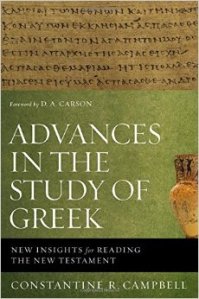
  1. Advances in the Study of Greek: New Insights for Reading the New Testament by Constantine R. Campbell (Zondervan 2015).
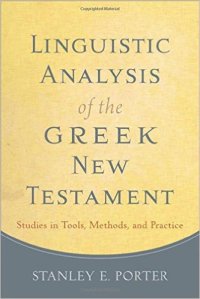
  2. Linguistic Analysis of the Greek New Testament: Studies in Tools, Methods, and Practice by Stanley E. Porter (Baker Academic 2015).

These are both intermediate level books that will get you up to speed on Greek studies.

Here are the chapter titles for Campbell’s book:Campbell_new book

  • A Short History of Greek Studies: The Nineteenth Century to the
    Present Day
  • Linguistic Theories
  • Lexical Semantics and Lexicography
  • Deponency and the Middle Voice
  • Verbal Aspect and Aktionsart
  • Idiolect, Genre, and Register
  • Discourse Analysis I: Hallidayan Approaches
  • Discourse Analysis II: Levinsohn and Runge
  • Pronunciation
  • Teaching and Learning Greek

The book is very helpfully organized. Campbell does an excellent job of boiling down the complex and confusing relationship between various schools of thought and different approaches on each topic. The book should be required reading for students studying Greek. Call me a nerd but I found it hard to put the book down I was enjoying it so much.

Porter’s book is a bit more rigorous and consequently demands a slower read. But don’t
mistake me, it is well worth it.  Porter is stronger on the theoretical side of things than he is on the application (i.e., exegesis of specific texts), in my opinion anyway. But the real strength of this book is the broad coverage of topics at the interface between linguistics and Greek studies.Porter_Linguistic Analysis

Here are the chapters:

  • Who Owns the Greek New Testament? Issues That Promote and Hinder Further Study
  • Analyzing The Computer Needs of New Testament Greek Exegesis
  • “On the Shoulders of Giants”: The Expansion and Application of the Louw-Nida Lexicon
  • Linguistics and Biblical Interpretation
  • A Multidisciplinary Approach to Exegesis
  • Sociolinguistics and New Testament Study
  • Discourse Analysis: Introduction and Core Concepts
  • The Ideational Metafunction and Register
  • Time and Aspect in New Testament Greek: A Response to K.L. McKay
  • Three Arguments regarding Aspect and Temporality: A Response to Buist Fanning, with Excursus on Aspectually Vague Verbs
  • The Perfect Tense-Form and Stative Aspect: The Meaning of Greek Perfect Tense-Form in the Greek Verbal System
  • A Register Analysis of Mark 13: Towards a Context of Situation
  • The Grammar of Obedience: Matthew 28:19-20
  • Verbal Aspect and Synoptic Relations
  • Study of John’s Gospel: New Directions or the Same Old Paths?
  • Method and Means of Analysis of the Opponents in Pauline Letters
  • 1 Timothy 2:8: Holy Hands or Holy Raising?
  • Greek Word Order: Still an Unexplored Area in New Testament Studies?
  • Proper Nouns in the New Testament
  • Hyponymy and the Trinity

Porter’s book demonstrates that those who assume Greek studies have come to a plateau, with nothing new to learn or discover, are wrong. With the tools and resources available today we are in a much better position to make advances in these areas than we were a generation ago. Most of the chapters were originally delivered at conferences (e.g., Society of Biblical Literature, Society for New Testament Studies, etc.), although none of them has been previously published. This book is a must read for anyone who desires to read the Greek New Testament with nuance and precision.

Upcoming Commentary Releases

09 Wednesday Sep 2015

Posted by thecruciformpen in Resources

≈ Leave a comment

Tags

Commentaries, New Releases

There are some good commentaries coming out soon. Here is a sample:

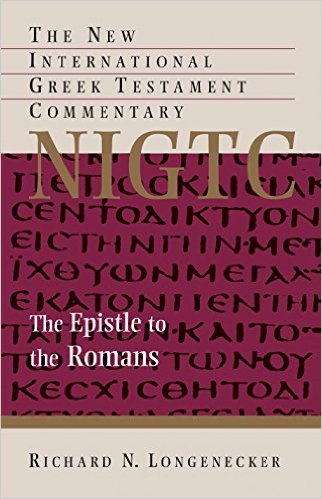
Richard N. Longenecker has written a commentary on Romans in the NIGTC series. Here is the link: The Epistle to the Romans Longenecker has previously written a top commentary on Galatians (ranked #1 on Bestcommentaries.com) for the Word Biblical Commentary series, so I am eager to see his work on Romans as well.

longenecker romans

For the Hermeneia series, J. J. M. Roberts (Old Testament professor at Princeton) has written a commentary on Isaiah 1-39. It is on pre-order now, scheduled to come out this December. Here is the link: First Isaiah

First isaiah

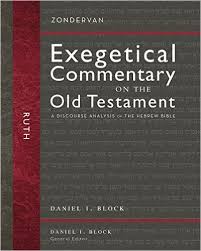
Daniel I. Block is coming out with one in the Zondervan Exegetical Commentary on the Old Testament series. Here is the link: Ruth: A Discourse Analysis of the Hebrew Bible Block is a professor of Old Testament at Wheaton College and has also written the top rated commentary on Ezekiel for the NICOT series.

Block

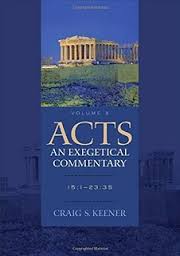
And finally, Craig S. Keener’s last volume on Acts is on pre-order. With this volume (the fourth) he will have completed his magnum opus–over 4,000 total pages of exegetical commentary on Acts! Here is the link: Acts:An Exegetical Commentary

Keener

‘Christ’: a Name, a Title or an Honorific? [New Book Notices]

06 Sunday Sep 2015

Posted by thecruciformpen in Resources

≈ Leave a comment

Tags

Christ, Judaism, Kingship, Messiah, Paul's Epistles, Pauline Theology, Pistis Christou

So what do you think? Is ‘Christ’ a name (i.e., a surname)? Perhaps a title (e.g., ‘King of Spain’)? Or what about an honorific (cf. ‘Augustus,’ which was given to the first century emperor Julius Caesar, who later became known simply as ‘Caesar Augustus’)?

For most of us the difference between these are not immediately obvious. However, there is a difference in meaning. And it is important that we try to understand the exact nuance that the word ‘Christ’ had for the writers of the New Testament.

Matthew Novenson

Matthew V. Novenson, Lecturer in New Testament and Christian Origins at the University of Edinburgh, has recently written an excellent book on this question. His thesis is surprisingly simple, yet with profound implications: Χριστος (Christos) in Paul’s letters means ‘Messiah.’ In other words, it is neither a name nor merely a title. It carries with it the nuances involved with “messiah language in ancient Judaism” (Novenson, pg. 3).

Here is a link to his book: Christ among the Messiahs: Christ Language in Paul and Messiah Language in Ancient Judaism

Christ among messiahs

Here is what N. T. Wright has said about it: “Novenson’s work now sets a new standard for discussion of Christos in particular, demonstrating that the way it functions linguistically, within the larger world of Greek usage in late antiquity, fits extremely well with royal ‘honorifics’ and not at all with proper names” (Paul and the Faithfulness of God, pg. 824).

On another front, Joshua W. Jipp, over at Trinity Evangelical Divinity School, is coming out with a new book on this topic soon. His position will bolster that of Novenson. “In the process, Jipp offers new and noteworthy solutions to outstanding questions concerning Christ and the law, the pistis Christou debate, and Paul’s participatory language” (from the blurb on the Fortress Press website)

Here is a link to his book: Christ is King: Paul’s Royal Ideology

Joshua Jipp_Christ is King

Here is a sample from the table of contents:

  1. Paul’s Christ-Discourse as Ancient Kingship Discourse
  2. King and Law: Christ the King as Living Law
  3. King and Praise: Hymns as Royal Encomia to Christ the King
  4. King and Kingdom: Sharing in the Rule of Christ the King
  5. King and Justice: God’s Righteousness and the Righteous King in Romans
  6. Conclusion

On Evaluating Children’s Story Bibles, and New Book Notices:

06 Sunday Sep 2015

Posted by thecruciformpen in Resources

≈ 1 Comment

Tags

Children, Family

I recently read two very interesting articles by David A. Shaw discussing how children’s story Bibles work and also providing a framework for evaluating them. The articles are excellently written and should be read by every parent or teacher who uses/reads these books to kiddos. One of the results of the articles is that I now realize a level of depth to the children’s story Bibles that we own and read. There is more to them than I first supposed.

Here are links to the articles (can be read for free over at Themelios):

  • Telling the Story from the Bible? How Story Bibles Work (Themelios 37:2)
  • Telling the Story from the Bible? (Part 2): Reviewing the Big Picture Story Bible and The Jesus Story (Themelios 38:1)

Speaking of children’s literature…there are some fantastic family titles being released soon. Here is a sample of some theologically rich children’s pieces on pre-order:

  • The Ology: Ancient Truths, Ever New

The Ology (kids systematic theology)

This is what you get when you combine a systematic theology and a children’s storybook. It’s a brilliant idea!

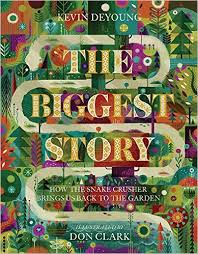
  • The Biggest Story: How the Snake Crusher Brings Us Back to the Garden

The Biggest Story

The illustrations alone make this book worth it, not to mention the focus on the grand narrative of Scripture!

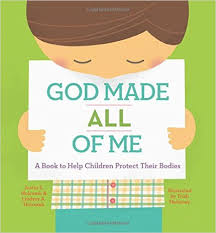
  • God Made All of Me: A Book to Help Children Protect Their Bodies

god made all of me

There is an important message here, especially relevant for kiddos growing up in this generation!

Commentary Sale!

04 Friday Sep 2015

Posted by thecruciformpen in Resources

≈ Leave a comment

Logos Bible Software has all the Word Biblical Commentaries for sale right now for $9.99 They are normally about $45 each.

Be sure to pick up a few!

Here is a link.

← Older posts
Newer posts →

Categories

  • Biblical Studies (20)
  • Historical Studies (12)
  • People to Know (27)
  • Poetry (2)
  • Prayers (7)
  • Research Topics / Book Ideas (3)
  • Resources (52)
  • Reviews (24)

Posts

  • February 2023 (1)
  • September 2022 (1)
  • October 2020 (1)
  • February 2020 (1)
  • December 2019 (1)
  • August 2019 (1)
  • February 2019 (3)
  • December 2018 (1)
  • June 2018 (1)
  • May 2018 (2)
  • March 2018 (6)
  • January 2018 (1)
  • November 2017 (1)
  • October 2017 (1)
  • May 2016 (4)
  • April 2016 (3)
  • March 2016 (10)
  • February 2016 (1)
  • January 2016 (4)
  • December 2015 (5)
  • October 2015 (1)
  • September 2015 (6)
  • February 2015 (1)
  • January 2015 (6)
  • December 2014 (12)
  • November 2014 (8)
  • October 2014 (1)

Enter your email address to follow this blog and receive notifications of new posts by email.

Join 46 other subscribers

Currently Reading

Blogs I Follow

  • Malcolm Guite
  • The Cruciform Pen
  • βιβλιοσκώληξ
  • Holy Writ & Sacred Witness
  • Griffin Paul Jackson
  • Koine-Greek
  • Biblical Studies
  • Bible Design Blog
  • Theological Studies
  • καὶ τὰ λοιπά
  • Euangelion
  • Evangelical Textual Criticism
  • NT Blog

Blog at WordPress.com.

Malcolm Guite

Blog for poet and singer-songwriter Malcolm Guite

The Cruciform Pen

toward a cross-shaped life

βιβλιοσκώληξ

βιβλιο: "book"; σκώληξ: "worm"

Holy Writ & Sacred Witness

...eyes on the Word; ears to the ground...

Griffin Paul Jackson

Word architect.

Koine-Greek

Studies in Greek Language & Linguistics

Biblical Studies

Bible Design Blog

Theological Studies

An Internet Resource for Studying Christian Theology

καὶ τὰ λοιπά

A blog by Daniel R. Streett all about Early Judaism, Biblical Studies, Koine Greek, καὶ τὰ λοιπά

Euangelion

toward a cross-shaped life

Evangelical Textual Criticism

toward a cross-shaped life

NT Blog

toward a cross-shaped life

  • Subscribe Subscribed
    • The Cruciform Pen
    • Join 46 other subscribers
    • Already have a WordPress.com account? Log in now.
    • The Cruciform Pen
    • Subscribe Subscribed
    • Sign up
    • Log in
    • Report this content
    • View site in Reader
    • Manage subscriptions
    • Collapse this bar
 

Loading Comments...