• Home
  • About
  • Resources

The Cruciform Pen

~ toward a cross-shaped life

The Cruciform Pen

Category Archives: Reviews

Three Recent Articles

05 Saturday Mar 2016

Posted by thecruciformpen in People to Know, Resources, Reviews

≈ Leave a comment

Tags

Intertextuality, Pauline Theology, Peter, Psalms, review, Textual Criticism

Here are three recently published articles that are pretty good reading:

  • “Another look at πιστις Χριστου” by Morna D. Hooker, Scottish Journal of Theology 69 (1): 46-62 (2016).
  • “The Number of Variants in the Greek New Testament: A Proposed Estimate” by Peter J. Gurry, New Testament Studies 62: 97-121 (2016).
  • “‘O Taste and See’: Septuagint Psalm 33 in 1 Peter” by Karen H. Jobes, Stone-Campbell Journal 18: 241-251 (Fall, 2015).

Let’s go in reverse order.

First, “O Taste and See” is classic Karen Jobes. She is an accomplished evangelical scholar on 1 Peter, with a top rated commentary on this epistle (see here). The article here is an exercise in intertextual interpretation looking at Peter’s exhortation to “crave pure, spiritual milk” (το λογικον αδολον γαλα επιποθησατε). Although sometimes understood as a reference to the word of God, Jobes rejects this reading. Instead by looking carefully at how Peter uses LXX Psalm 33 it makes better sense to see a reference to Christ himself as the pure, spiritual milk “which nurtures growth of spiritual life after rebirth into the new reality that Christ’s death, resurrection, and ascension has created…To crave the pure spiritual milk means to crave Christ himself, for only he can sustain the new life he created” (pgs. 249-250).

Second, Peter J. Gurry’s article on the number of textual variants in the GNT is a solidly researched article with an important find. Despite my hunch that there are probably only a small number of people interested in this type of research, it is nevertheless hugely important to get this kind of information correct. After a lengthy section discussing previous historical estimates, their problems, and his own methodology, Gurry proposes an estimate of about 500,000 variants (not including spelling differences). He only analyzes variants found in Greek manuscripts; that is, papyri, majuscules, minuscules and lectionaries, NOT versions, patristic citations, inscriptions, etc. (pg. 104). He defines a variant as “a word or concatenation of words in any manuscript that differs from any other manuscript within a comparable segment of text, excluding only spelling differences and different ways of abbreviating nomina sacra” (pg. 106). I will just add one more concluding thought on the value of the estimate:

“[O]ur estimate allows scholars to avoid passing the responsibility for their estimates to silent and invisible sources. The present estimate is based on a clear foundation in the available data and a clear method, both of which are open to public scrutiny. One hopes that these two qualities alone will be enough to discourage all of us from the continued rehashing of unverified and unverifiable information about the transmission of the Greek New Testament.” (pg. 118)

Third, “Another look at πιστις Χριστου” by Morna Hooker. The sheer amount of scholarly attention given to this phrase indicates the importance of it. Subjective genitive or objective genitive? Christ’s faith/faithfulness or our faith in Christ? In this paper, Hooker builds on her earlier work (‘Πιστις Χριστου’, New Testament Studies 35, 1989) by zeroing in on what exactly is meant by πιστις (pistis), particularly in some key texts in Romans. In doing so, she explores the relationship of human behavior and divine grace in the apostle Paul’s thought. She concludes by asking the question,

“So were Luther and his followers wrong? They were certainly not wrong to emphasize the role of faith. And as with the answers to our questions about other phrases we have briefly considered, it may well be that the answer to the question ‘Does this phrase refer to Christ’s faith or ours’? may be ‘Both’. Nevertheless, the faith/faithfulness is primarily that of Christ, and we share in it only because we are in him…In Christ, and through him, we are able to share his trust and obedience, and so become what God called his people to be.” (pg. 62)

A Narrative Model for Active Reading

18 Monday Jan 2016

Posted by thecruciformpen in Biblical Studies, Resources, Reviews

≈ Leave a comment

Tags

Gospels, Jonathan Pennington, Narrative

penningtonJonathan Pennington, in Reading the Gospels Wisely: A Narrative and Theological Introduction, offers the following strategy for actively reading the Gospel narratives. He introduces his model by contrasting it with another common study method he calls the “Whatever Strikes Me” model (pg.171):

For many readers of narrative the meaning one comes away with is usually based on what we may call the “WSM Hermeneutic”–“Whatever Strikes Me.” That is, most readers–whether brand-new to the Gospels or lifelong readers–simply read the stories and take away from them whatever comes to mind, whatever stands out to them this time. At times this approach will be sufficient, thanks either to luck or to the intuitions of a generally skilled reader. But overall, for wise reading we need a more solid understanding of how stories work–how they speak and communicate–so that we can learn to read the Gospel narratives well and to adjudicate wisely among various good readings. We need a model for narrative analysis.


(for the following strategy see pgs.175-176; and esp. pgs. 202-203):

  • Isolate the Literary Unit

First, we need to determine the parameters of the story. What is the proper demarcation of the episode? Usually in the Gospels this will be clearly indicated by the paragraph breaks given in our Bibles.

  • Read the Story Multiple Times

We must keep the whole experience of the story at the forefront rather simply jumping right into analysis. Read it slowly. Read in quickly. Read it silently. Read it aloud. (If you can read it in Greek, all the better!)

  • Identify the Setting and the Characters

It is helpful to simply state what the setting is and to list all the characters. Who is here and where is this story happening?

  • Observe the Story

Are there key words or phrases or repeated ideas? Are cause-and-effect relationships stated? What illustrations are used , if any?Noting all these things will help you pay closer attention to the story. Ask questions of the text and write them down. Explore the text with an open mind. There are no stupid questions or observations!

  • Isolate the Different Scenes

At this stage it is helpful to take the whole pericope and simply break it up into different scenes (note above comments). The first scene will usually be the setting.

  • Analyze the Narrative:
    • Identify the Rising Tension
    • Identify the Climax
    • Identify the Resolution
    • Identify the Following Action/Interpretation
  • Think About the Contexts
    • Acts, Cycles, and Literary Structures
      • An act consists of several sequentially related stories together, and a cycle, a number of acts strung together. For example, the three lost/found parables in Luke 15 are all meant to be read as a unit (an act), and likewise Jesus’ journey to Jerusalem in Luke 9:51-19:27 is one large section (a cycle) with many acts within it (pg .186).
      • Sometimes several episodes are combined into literary structures in such a way that creates a greater meaning being communicated than individual episodes can give by themselves. A literary structure may be discerned when a series of episodes itself has a point and theme that goes beyond any individual pericope (pgs. 186-189). Pennington perceptively discerns a literary structure in Matthew 21-23 focused on Jesus as the son of David and the rejection of the Jewish leadership in Jerusalem.
    • The Whole Gospel Context Including Intratextuality, the Fourfold Gospel Book, and Jesus’ Death and Resurrection
      • Intratextuality = allusions to any particular story elsewhere in the same Gospel, thereby indicating that we should read these accounts in light of each other (pg.189). Pennington gives the following as some examples: Jesus’ predictions of his own impending death and resurrection, and also the appellation “king of the Jews” in the early chapters of Matthew in reference to Jesus instead of Herod.
      • Fourfold Gospel Book = Since what we are given in the Holy Gospels is not just individual stories or even individual books but rather a fourfold book, the best readings of any episode take into account relevant information from the rest of the Gospels canon. A good synopsis is valuable for this. By noting the similarities and differences between how the four evangelists tell their stories we can gain insight into how that particular evangelist develops his plot and motifs (pg. 192). To use a phrase that Abraham Kuruvilla uses often, “What is the author doing with what he is saying?”
      • Jesus’ Death and Resurrection = the focal point of the entire Gospel narratives (as indicated by the relative space given to the events surrounding Jesus’ final week). This means that any individual episode, act, or cycle must be read in the light of Jesus’ passion in order to understand it’s full significance. The sermon on the mount is given as an example of a unit whose full significance only comes to light after Jesus’ passion (pg. 195).
    • The Kingdom-Focused, Redemptive-Historical Context of the whole Canon
      • When we read the Gospels in light of the entire canon, we see that even the elaborate and complex stories of the Gospels do not exist in a vacuum but are clearly situated as part of the larger story of the whole Bible (pg.198).
  • Summarize the Pericope
    • This final step in the narrative model for active reading is important for forcing us to articulate what is most significant in a particular story. When writing the summary be sensitive to the narrative flow, characterization, and the various contexts as they affect its meaning (pg. 203).


The “Glory of God” in Romans

15 Friday Jan 2016

Posted by thecruciformpen in Biblical Studies, People to Know, Reviews

≈ Leave a comment

Tags

Apocalyptic Interpretation, Beverly Gaventa, Glory of God, Pauline Theology, Romans

Interpretation and the Claims of the TextI recently read a fascinating chapter by Beverly Gaventa on “The ‘Glory of God’ in Paul’s Letter to the Romans”. Gaventa contributed this chapter in the book Interpretation & the Claims of the Text: Resourcing New Testament Theology (Baylor University Press, 2014), a collection of essays in honor of Charles Talbert.

On the premise that relatively little scholarly work has been done on the phrase “the glory of God” (δοξα του θεου) in Paul’s letters Gaventa sets out to demonstrate three things (pg.29):

  1. That “glory of God” is an important motif in Romans
  2.  That it draws on earlier Jewish associations connecting God’s glory with God’s salvific presence
  3. That it plays a role in Paul’s apocalyptic interpretation of the gospel

In her survey of glory of God language in Romans, Gaventa highlights two particularly disputed passages: Romans 3.23 and 5.2.

With regard to Romans 3.23 Gaventa makes two moves. Firstly, she suggests that it should be translated (following Leander Keck and also The New American Bible) as follows: “all are deprived of the glory of God”. This brings our the passive voice of the verb (contra. the more common renderings “lack” or “fall short of”). Secondly, she draws attention to what exactly is meant by “glory of God” in the claim that humanity is deprived of it. She concludes that Paul “refers not to humanity’s own original state of glory but to the loss of its proper, worshipful relationship to God” (pg.31). As a side note, the Good News Translation of the Bible supports Gaventa’s reading of the glory-of-God language in this verse: “everyone has sinned and is far away from God’s saving presence” (Rom 3.23 GNB).

In regard to Romans 5.2, the phrase is usually read as hope for humanity’s own eschatological glory. Gaventa suggests rather that to hope in the glory of God means to expect God’s triumphant presence.

This leads into her discussion of how the Old Testament and other Jewish literature uses glory-of-God language to refer to God’s own presence (e.g. inter alia Ex 24.16; 40.34; Lev 9.23; Ps 56.6; Ezek 11.23). But she points out that in many places it is not just a general presence that is signified by the phrase “it is God’s presence as that presence powerfully triumphs over God’s intractable enemies” (pg.33, emphasis added). In other words, “God’s δοξα is not just God’s presence, but God’s presence for the purpose of an eschatological establishment of God’s saving kingdom” (pg.34).

This claim is supported by a survey of the ubiquitous, but little noticed, conflict language throughout Romans. Again, she concludes that “the ‘glory of God’ signals not only God’s own presence but something more — God’s presence as it triumphs over God’s own enemies, most especially the enemies named Sin and Death” (pg.36).

Among other ramifications of this reading for understanding Paul is that the resurrection of Jesus from the dead is not primarily a proof of his divinity or his identity as the messiah (although it is that, to be sure), but instead the “beginning of God’s triumph. That is why Paul can go on to say in Romans 6.9-10 that Death and Sin no longer rule over Christ; they have been defeated by the “glory of the father” (pg.36).

More could be said but I will stop here. Gaventa has certainly given us something to consider which has profound implications for how we understand a concept as important as the glory of God. As always her work is thought provoking and well worth the reading.

Soli Deo gloria.

What was the motivation for the Incarnation?

10 Saturday Oct 2015

Posted by thecruciformpen in Reviews

≈ Leave a comment

Tags

Christology, Incarnation, Sin

incarnation anywayI recently finished an interesting read: Incarnation Anyway: Arguments for Supralapsarian Christology by Edwin Chr. van Driel (Oxford University Press, 2008). The book deals with the question of God’s motivation for the incarnation. Was it contingent upon sin, or did the triune God have a deeper motive in becoming human? As the title of the book suggests, van Driel argues for the latter. He proposes that God’s desire for intimate friendship and love with his creation has the most explanatory power for understanding the incarnation. Understanding the incarnation, in other words, as merely a divine response to sin does not do justice to the full beauty and majesty of Immanuel, God with us.


It may be important to compare and contrast this book with another of a similar strand. Van Driel comes to very similar conclusions on this topic as the traditional Greek Orthodox viewware_orthodox_way has it. For example, Kalistos Ware, in his book The Orthodox Way (St. Vladimir’s Seminary Press, 1979), says the incarnation “is God’s supreme act of deliverance, restoring us to communion with himself. But what would have happened if there had never been a fall? Would God have chosen to become man, even if man had never sinned?” (pg. 70). Following the lead of St. Isaac the Syrian (Bishop of Nineveh, late 7th century) Ware suggests that “Even had there been no fall, God in his own limitless, outgoing love would still have chosen to identify himself with his creation by becoming man” (pg. 70).

However, an important difference here is van Driel’s refusal to postulate a hypothetical scenario of unfallen humanity. Speculating about an unreal situation does not help us understand the motivation for the incarnation. Rather than engage in speculation van Driel insists that we deal directly with the situation that has in fact obtained: “I do not ask what would have happened if we had not sinned; I ask about the incarnation as it happened, about the Christ as we have him; and my point is that the incarnation gives us so much, is so rich in gifts of divine friendship and intimacy, that it cannot be explained as only a divine countermeasure against sin…the category of redemption is not rich enough to explain the wonder of his presence” (pg. 164-65).

Van Driel is not trying to minimize the importance of redemption from sin. Rather, he is trying to highlight the magnificence and majesty that is displayed in the incarnation, and suggesting that if we think of the incarnation as only a divine response to sin then we are flattening out God’s purpose in becoming human. The practical implications of this are important for 1) our spiritual walk with God, and 2) our evangelism.

If the incarnation is merely a divine countermeasure against sin, that assumes that our relationship to him is based on a problem-solution model; the fall of humanity into sin is the problem, God’s solution is redemption (via the incarnation). The problem with this model, according to van Driel, is that once the solution is obtained there is no further need for a continued relationship with the incarnate Christ. In other words, what further need is there for Christ to remain incarnate once the redemption has been accomplished? The problem (sin) has been dealt with, atonement has been made. Van Driel’s proposal is that God’s motive goes beyond a mere countermeasure for sin. God desires to be as close as possible with his creatures in love and friendship. And because this desire came before sin there is abundant reason for us to continue to engage with him daily in intimate friendship, and further, the deeper motive for Christ to remain human, even now, still stands.

The other practical implication relates to our evangelism. Van Driel suggests that to suppose the incarnation is contingent upon our need for redemption leads to the improper conclusion that before we can introduce someone to Christ we must first convince them that they are sinners, and therefore need redemption. Although, van Driel doesn’t use this analogy, I think he would say this is putting the proverbial cart before the horse. He is not saying that we are not sinners who need redemption. Rather, he is laying out a vision of the incarnation in which the love of God precedes the need of redemption, and therefore serves as a more acceptable starting point for inviting people into a living relationship with this God.

This was a fascinating read. I find myself sympathetic with the main thrust of the book. However, I can’t help but wonder if van Driel has really understood the biblical-theological significance of sin. We live in a society where moral relativism rules the day. I think it is important for us to grapple with the biblical teaching on sin and its contemporary significance. Additionally, as for the motive behind the incarnation, it is a false dichotomy to suggest that it must be either a countermeasure against sin or a step toward loving fellowship with humanity; I think the two are intricately bound up with one another. To separate them as mutually exclusive motives for the incarnation creates an unnecessary disjunction in the purpose of God. Even human beings can havefallen complex motives for action. Is it wrong to suppose God had complex motives?

In sum, I think Incarnation Anyway is worth thoughtful study, but it would be helpful to supplement with another book on the topic of sin. So read it alongside Fallen: A Theology of Sin (Crossway, 2013), an excellent  compilation of essays written by evangelical scholars (D.A. Carson, Douglas Moo, Paul House, Gerald Bray, Bryan Chapell, Sydney Page, Robert W. Yarbrough, etc.).

Did Jesus think of Israel as still suffering exile?

30 Wednesday Sep 2015

Posted by thecruciformpen in Reviews

≈ Leave a comment

Tags

Craig Evans, Exile, Jesus, New Exodus, Restoration

Did Jesus think of Israel as still suffering exile? Was part of his agenda the bringing to an end of Israel’s exile and the establishing of restoration as foretold in the prophets of old? These are some of the questions that Craig A. Evans wrestles with in a chapter titled “Aspects of Exile and Restoration in the Proclamation of Jesus and the Gospels” (found in the book Jesus in Context: Temple, Purity, and Restoration published by Brill).

evans

The chapter is fairly straightforward. Evans demonstrates (with plenty of examples from Second Temple literature) that many Jews during the intertestamental period considered themselves as still in exile. Although many Jews lived in the land again, nevertheless the fact that so many Jews remained in the diaspora indicated that the great in-gathering of Israel’s exiles had not happened. Exile continued. As for those who did live in the land of Israel, under Roman rule, they knew all to well that liberation from foreign oppressors had not obtained. They were still in exile awaiting national redemption. Further, Evans shows from the NT how this exile theology sheds light on many of Jesus’ words and actions. In the end he concludes, “Jesus identified himself and his mission with an oppressed Israel in need of redemption and that he himself was the agent of that redemption. He was the Danielic “son of man” to whom kingdom and authority were entrusted. He was the humble Davidic king of Zechariah’s vision who entered the Temple precincts and offered himself to the High Priest and took umbrage at Temple polity. And, of course, he was the eschatological herald of Second Isaiah who proclaimed the “gospel” of God’s reign and the new exodus. All of this suggests that, among other things, Jesus understood his message and ministry as the beginning of the end of Israel’s exile.” (293)

This is a stimulating topic that deserves careful study. Evans has done a great service by bringing together a host of texts from Second Temple literature and suggesting how they may contribute to our understanding of Jesus in his own context. Worth the read.

Walter C. Kaiser, Jr. on Suffering

16 Friday Jan 2015

Posted by thecruciformpen in Resources, Reviews

≈ Leave a comment

Tags

Suffering, Walter C. Kaiser

In his book Grief & Pain in the Plan of God: Christian Assurance and the Message of Lamentations Walter C. Kaiser, Jr. offers the following typology of suffering in the Old Testament (see pgs. 128-136):

  1. Retributive Suffering
  2. Educational or Disciplinary Suffering
  3. Vicarious Suffering
  4. Empathetic Suffering
  5. Doxological Suffering
  6. Evidential or Testimonial Suffering
  7. Revelational Suffering
  8. Eschatological or Apocalyptic Suffering

Here in the conclusion to the book, Kaiser has a brief discussion of each type of suffering with biblical examples. These are helpful categories to have tucked away in your mind so that when we see suffering (in our own lives or in the world around us) we don’t commit the same error as Job’s friends, automatically assuming it to be one kind of suffering when actually there is something else going on. Here is how Kaiser concludes (pgs. 135-136):

Suffering then is multiplex in its causes, purposes, and explanations. All attempts to reduce the explanation of suffering both in that day and ours to a single reason, such as retributive suffering, could earn the quick rebuke of God as it did for Job’s three friends. Let us be biblically sensitive and spiritually alert to the wholeness of God’s revelation, and let us be reticent to postulate total patterns based on the presence of a single swallow.

Let us bow before our Maker and recognise His infinite wisdom in His distinctive and numerous reasons for suffering. And when none of these eight explanations, or any additional reasons that may have eluded us here, seems to fit our own moment of crisis, then let us return to the lodestone and central affirmation of the book of Lamentations: ‘Great is Thy faithfulness.’

This book is available on Amazon as well as Logos.

Some Reflections on Richard B. Hays’ New Book

03 Saturday Jan 2015

Posted by thecruciformpen in Reviews

≈ Leave a comment

Tags

Gospels, Richard B. Hays

reading backwards

Richard B. Hays’ new book, Reading Backwards: Figural Christology and the Fourfold Gospel Witness, is a short read but there is a lot to digest in its 109 pages. Each of the four Gospels is given a chapter. In this post I will limit my reflections to his chapter on the Gospel of Mark.

By way of review about the book in general, in the preface Hays states clearly that the book is an

account of the narrative representation of the identity of Jesus in the canonical Gospels, with particular attention to the ways in which the four Evangelists reread Israel’s Scripture, as well as the ways in which Israel’s Scripture prefigures and illuminates the central character in the Gospel stories.

For Hays, the concept of ‘mystery’ is essential for understanding how Mark crafts his narrative around the person of Jesus. He points out that Mark is generally more cryptic and allusive than Matthew (who much more often states explicitly “This took place to fulfill what had been spoken through the prophet , saying…”). Mark’s strategy of indirect reference and subtle allusions to the Old Testament cautions us against speaking too quickly about the mysterious identity of the Carpenter from Nazareth. In other words, there is something crudely wrong with stating so blatantly and matter-of-factly that “Jesus is the God of Israel.” Such a brash declaration fails to do justice to the transcendence and profoundness of the truth contained in the affirmation. And some might even say that kind of statement oversimplifies an incredibly complex identity; Hays quotes Rowan Williams, “There is a kind of truth which, when it is said, becomes untrue” (31). The point is that the identity of Jesus cannot be boiled down into such an unqualified two-dimensional statement. Instead, Mark chooses to drop dynamic hints about the identity of Jesus by way of careful selection of stories (and careful telling of those stories), hints that leave the reader to silently ponder who this Jesus was, drawing his categories from the Old Testament.

Here is how Hays concludes his interpretation of Mark’s figural Christology (an interpretation which he notes is not far from the way Mark’s Gospel is read in the Orthodox tradition):

So, if we seek to read Scripture through Mark’s eyes, what will we find? We will find ourselves drawn into the contemplation of a paradoxical revelation that shatters our categories and exceeds our understanding. We will learn to stand before the mystery in silence, to acknowledge the limitation of our understanding, and to wonder. The ‘meaning’ if Mark’s portrayal of the identity of Jesus cannot be rightly stated in flat propositional language; instead, it can be disclosed only gradually in the form of narrative, through hints and allusions that project the story of Jesus onto the background of Israel’s story. As Mark superimposes the two stories on one another, remarkable new patterns emerge, patterns that lead us into a truth too overwhelming to be approached in any other way.

I do have some questions about how Hays establishes an Old Testament allusion. As one example, at times Hays seems to rest his reading of the OT allusion on the repetition of a couple key phrases (and perhaps also thematic similarity?). I want to ask, is the repetition of phrases enough to establish an admittedly cryptic allusion? It would be nice if more evidence could be adduced to demonstrate the presence of an allusion.

Notwithstanding my unanswered questions, I deeply appreciate this kind of reading of Mark’s gospel. As a footnote, I think it provides a convincing explanation of the shorter (in my opinion, genuine) ending of Mark. If the shorter ending is original, then Mark ends his gospel with this authorial comment: “Trembling and bewildered, the women went out and fled from the tomb. They said nothing to anyone, because they were afraid” (Mark 16:8). This mysterious concluding statement has generated a history of complex textual emendations and additions by scribes in the centuries to follow Mark’s writing. Why would Mark end his gospel in such an unexpected way? Well, if Hays’ reading is correct then it should not be so unexpected after all. Mark has been preparing his readers for this kind of reaction all along. As Hays puts it,

readers who listen carefully to the resonances of Israel’s Scripture in Mark’s Gospel and then see how the story drives toward the passion narrative may find themselves, like the women in Mark’s artful dramatic ending, reduced, at least for a time, to silence…The fear of the women is, of course, a response to the message of the resurrection of Jesus the Crucified One. I would suggest that a similar response of reticent fear and trembling is equally appropriate when we read the story of the crucifixion, if we have rightly followed Mark’s narrative clues about the identity of the one on the cross.

To this I simply offer a hearty AMEN and AMEN!

A Day Sanctified

02 Friday Jan 2015

Posted by thecruciformpen in Reviews

≈ Leave a comment

Tags

Jürgen Moltman, Sabbath

moltmannI just read an article that made me think of the Sabbath in a way that I have not thought of before. Jürgen Moltmann (“The Sabbath: The Feast Of Creation.” Journal Of Family Ministry 14.4 [2000]: 38-43) talks about the nature of the Sabbath in some pretty profound ways. I’ll just share a few thoughts worth pausing over. First, he notes that in the Genesis account God’s blessing of the Sabbath is unique because previously God had blessed only things. For example, God blesses the sea creatures and birds of the air (1:22) and he also blesses the man and woman (1:28). But when he blesses the Sabbath (2:3) he is not blessing a thing but rather a day, that is, a time. “God does not bless this day through activity, but rather through his rest; not by creating, but rather by being there. In this day God is wholly present” (40). Commenting on Augustine’s famous dictum, ‘our heart is restless in us until it finds rest in thee’, Moltmann points out that restlessness is universal among mortal creatures. So where is the refuge? the place of rest? “It is in time–here and now–on the seventh day, God’s Sabbath. On this day God simply is. All creatures therefore find there place…in the calm of God’s presence” (40). So, because on the Sabbath God blessed a time and not a thing this means that in a sense his blessing is universally available to all creatures who exist in this time, that is, the Sabbath.

And yet, as a spacio-temporal blessing the Sabbath points forward and backward, according to Moltmann. It points backward because it beckons us to remember creation (the day of blessing from the Creator). It points forward because on the Sabbath (in a uniquely blessed way) we may experience life in the presence of the Living God. I’ll close with a quote in which Moltmann makes an interesting analogy between the Sabbath day and the function of temples in the ancient world:

In the limited temples of the peoples, heaven and earth touch, but in the Jewish Sabbath, time and eternity touch. That way the Sabbath is both a day of remembrance of the original creation and a day of hope in our final salvation. Beginning and End are present on this day, interrupting time and indeed rescinding it. On this day death is abolished, for life is experienced so deeply that it is eternal. On this day the law of time is put away, for God himself lives in this day: eternal presence in an instant of time.

The Incarnation and Limited Atonement

29 Monday Dec 2014

Posted by thecruciformpen in Reviews

≈ Leave a comment

Tags

Covenant Theology, James B. Torrance, Limited Atonement

I recently read an article by James B. Torrance titled “The Incarnation and ‘Limited RevProfJamesBTorranceAtonement'” [Evangelical Quarterly 55 (1983): 83-94]. Torrance takes a position against the doctrine of ‘limited atonement’ as he understands it. While I remain finally unpersuaded concerning his arguments against limited atonement, there was still a lot of good stuff in his article. Here are my two main take-aways: (1) He has an excellent discussion about the consequences of starting with the doctrine of the incarnation vs. the doctrine of election, and the divergent implications this starting point has for how we construct our doctrine of God. (2) Regarding historical theology there is a fascinating sketch of the emerging of “so-called ‘federal Calvinism’ or Covenant Theology which was to develop in England, Scotland, and Holland” (see pgs. 88-93).

Satan: God’s Servant

18 Thursday Dec 2014

Posted by thecruciformpen in Reviews

≈ Leave a comment

Tags

Biblical Theology, Canon, Old Testament Theology, Satan, Sydney Page

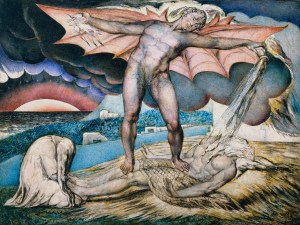
Satan

Sydney Page has a fascinating article about Satan [“Satan: God’s Servant.” Journal Of The Evangelical Theological Society 50.3 (2007): 449-465]. More specifically, it is about the biblical portrayal of the Satan figure. More often than  not, our thinking about angelic beings and mysterious figures like Satan is shaped more by popular imagination, movies, and artwork (like William Blake’s historical piece above). Page has gifted the church with a sound biblical basis for thinking about Satan.

In the article he studies the story of Job (and Satan’s role in the Job account). He demonstrates convincingly how “the Joban conception of Satan exercised significant influence on the rest of the biblical canon…how Satan is portrayed as a servant of God in Job, then…how later biblical texts pick up and use the Joban ideas” (449). Here is a great example how later biblical texts can echo earlier ones. And conversely, how earlier biblical texts can affect later ones. (Similar to Richard B. Hays’ project on the Gospels and also Paul)

The motif that Page finds recurring in various forms in the developing biblical tradition around the Satan figure has to do with Satan’s inimical subordination to God: “Although there is incontrovertible evidence of change and development in the concept of Satan in the biblical literature, this basic notion that Satan is under divine control appears repeatedly” (465). This has significant implications for our doctrine of God and the age old questions of theodicy.

One of the take-aways from the article relates to how we speak about Satan: “One must, therefore, be careful to avoid exaggerating the power of Satan and setting up a dichotomy between God and Satan that would suggest a particular action must be attributed to either one or the other. These alternatives are not mutually exclusive. Satan is God’s adversary, but whatever he does falls under the overarching sovereignty of God” (465).

← Older posts
Newer posts →

Categories

  • Biblical Studies (20)
  • Historical Studies (12)
  • People to Know (27)
  • Poetry (2)
  • Prayers (7)
  • Research Topics / Book Ideas (3)
  • Resources (52)
  • Reviews (24)

Posts

  • February 2023 (1)
  • September 2022 (1)
  • October 2020 (1)
  • February 2020 (1)
  • December 2019 (1)
  • August 2019 (1)
  • February 2019 (3)
  • December 2018 (1)
  • June 2018 (1)
  • May 2018 (2)
  • March 2018 (6)
  • January 2018 (1)
  • November 2017 (1)
  • October 2017 (1)
  • May 2016 (4)
  • April 2016 (3)
  • March 2016 (10)
  • February 2016 (1)
  • January 2016 (4)
  • December 2015 (5)
  • October 2015 (1)
  • September 2015 (6)
  • February 2015 (1)
  • January 2015 (6)
  • December 2014 (12)
  • November 2014 (8)
  • October 2014 (1)

Enter your email address to follow this blog and receive notifications of new posts by email.

Join 46 other subscribers

Currently Reading

Blogs I Follow

  • Malcolm Guite
  • The Cruciform Pen
  • βιβλιοσκώληξ
  • Holy Writ & Sacred Witness
  • Griffin Paul Jackson
  • Koine-Greek
  • Biblical Studies
  • Bible Design Blog
  • Theological Studies
  • καὶ τὰ λοιπά
  • Euangelion
  • Evangelical Textual Criticism
  • NT Blog

Blog at WordPress.com.

Malcolm Guite

Blog for poet and singer-songwriter Malcolm Guite

The Cruciform Pen

toward a cross-shaped life

βιβλιοσκώληξ

βιβλιο: "book"; σκώληξ: "worm"

Holy Writ & Sacred Witness

...eyes on the Word; ears to the ground...

Griffin Paul Jackson

Word architect.

Koine-Greek

Studies in Greek Language & Linguistics

Biblical Studies

Bible Design Blog

Theological Studies

An Internet Resource for Studying Christian Theology

καὶ τὰ λοιπά

A blog by Daniel R. Streett all about Early Judaism, Biblical Studies, Koine Greek, καὶ τὰ λοιπά

Euangelion

toward a cross-shaped life

Evangelical Textual Criticism

toward a cross-shaped life

NT Blog

toward a cross-shaped life

  • Subscribe Subscribed
    • The Cruciform Pen
    • Join 46 other subscribers
    • Already have a WordPress.com account? Log in now.
    • The Cruciform Pen
    • Subscribe Subscribed
    • Sign up
    • Log in
    • Report this content
    • View site in Reader
    • Manage subscriptions
    • Collapse this bar
 

Loading Comments...