Reading on Exile

Tags

, , ,

Jewish diaspora

Sometimes the best suggested reading lists come from footnotes. I recently read a book or two on the topic of exile and here is a list of books I compiled from the footnotes. This would be a fantastic summer (or winter) reading list!


Writing Exile: The Discourse of Displacement in Greco-Roman Antiquity and Beyond, edited by Jan Felix Gaertner (Brill)

Restoration: Old Testament, Jewish, and Christian Perspectives, edited by James M. Scott (Brill)

Exile and Restoration: A Study of Hebrew Thought of the Sixth Century B.C., by Peter R. Ackroyd (Westminster John Knox)

A Narrative Theology of the New Testament: Exploring the Metanarrative of Exile and Restoration, by Timo Eskola (Mohr Siebeck)

Leading Captivity Captive: ‘The Exile’ as History and Ideology, edited by Later L. Grabbe (Sheffield)

The Land of Israel as a Political Concept in Hasmonean Literature: Recourse to History in Second Century B.C. Claims to The Holy Land, by Doron Mendels (J.C.B. Mohr)

The Crisis of Israelite Religion: Transformation of Religious Tradition in Exilic and Post-Exilic Times, edited by Bob Becking and Marjo C.A. Korpel (Brill)

Lord of the Banquet: Literary and Theological Significance of the Lukan Travel Narrative, by David P. Moessner (Fortress)

The Qumran Community, by Michael A. Knibb (Cambridge)

From Joshua to Caiaphas: High Priests After the Exile, by James C. VanderKam (Augsburg Fortress)

Song of Exile: The Enduring Mystery of Psalm 137, by David W. Stone (Oxford)

Exile: Old Testament, Jewish, and Christian Perspectives, edited by James M. Scott (Brill)

Ezekiel and the Ethics of Exile, by Andrew Mein (Oxford)

Israel in Exile: A Theological Interpretation, by Ralph W. Klein (Fortress)

Jesus and the Restoration of Israel: A Critical Assessment of N.T. Wright’s Jesus and the Victory of God, edited by Carey C. Newman (IVP Academic)

Jesus, the Tribulation, and the End of Exile: Restoration Eschatology and the Origin of the Atonement, by Brant Pitre (Baker Academic)

The Death of Jesus in Matthew: Innocent Blood and the End of Exile, by Catherine Sider Hamilton (Cambridge)

Ancient Jewish Letters and the Beginnings of Christian Epistolography, by Lutz Doering (Mohr Siebeck)

The Restoration of Israel: Israel’s Re-gathering and the Fate of the Nations in Early Jewish Literature and Luke-Acts, by Michael E. Fuller (De Gruyter)

Resurrection and the Restoration of Israel: The Ultimate Victory of the God of Life, by Jon D. Levenson (Yale)

Envisioning Judaism, edited by Ra’anan Boston, Klaus Herrmann, Remind Leicht, Annette Reed, and Giuseppe Veltri (Mohr Siebeck)

A Biblical Theology of Exile, by Daniel Smith-Chrstopher (Augsburg Fortress)

Exile and Restoration Revisited: Essays on the Babylonian and Persian Periods in Memory of Peter R. Ackroyd, edited by Gary Knoppers and Lester Grabbe (T&T Clark)

Enduring Exile: The Metaphorization of Exile in the Hebrew Bible, by Martien Halvorson-Taylor (Brill)

The Ten Lost Tribes: A World History, by Zvi Ben-Dor Benite (Oxford)

The Prophets Speak on Forced Migration, edited by Mark Boda, Frank Ames, John Ahn, and Mark Leuchter (SBL)

Exile as Forced Migrations: A Sociological, Literary, and Theological Approach on the Displacement and Resettlement of the Southern Kingdom of Judah, by John Ahn (De Gruyter)

Rejection: God’s Refugees in Biblical and Contemporary Perspective, edited by Stanley Porter (Pickwick)

Exile: A Conversation with N.T. Wright, edited by James M. Scott (IVP Academic)


Two New Text Critical Resources

If you are interested in textual criticism, then you might be interested in these two new resources from Peter J. Gurry dealing with the Coherence-Based Genealogical Method (used in the NA28).

One is available now from Brill (click here): A Critical Examination of the Coherence-Based Genealogical Method in New Testament Textual Criticism

Peter Gurry_new text critical book

The other is being released next month, put out by SBL Press (available for pre-order on Amazon HERE): A New Approach to Textual Criticism: An Introduction to the Coherence-Based Genealogical Method (Gurry co-authored it with Tommy Wasserman)

Here is the blurb from Amazon:

An essential introduction for scholars and students of New Testament Greek

With the publication of the widely used twenty-eighth edition of Nestle-Aland’s Novum Testamentum Graece and the fifth edition of the United Bible Society Greek New Testament, a computer-assisted method known as the Coherence-Based Genealogical Method (CBGM) was used for the first time to determine the most valuable witnesses and establish the initial text. This book offers the first full-length, student-friendly introduction to this important new method. After setting out the method’s history, separate chapters clarify its key concepts such as genealogical coherence, textual flow diagrams, and the global stemma. Examples from across the New Testament are used to show how the method works in practice. The result is an essential introduction that will be of interest to students, translators, commentators, and anyone else who studies the Greek New Testament.

Features

  • A clear explanation of how and why the text of the Greek New Testament is changing
  • Step-by-step guidance on how to use the CBGM in textual criticism
  • Diagrams, illustrations, and glossary of key terms


John Webster Died

Tags

I was sad to hear that John Webster died on Wednesday 25 May 2016. 

I first heard the name of John Webster when I was a student at bible college. My professor said that he was one of the most brilliant theologians alive. 

As a member of the Anglican Communion Webster was truly a bridge between the church and academy. He had a gift of being both excruciatingly precise and immensely profound with his words. He was a master of saying much with as few words as possible. His command of the Emglish language was beautiful and influential. He made theology irresistible. And, perhaps most importantly, he was an intellectually rigorous and capable defender of the evangelical faith in the academy. 

John Webster has left a legacy of thinking deeply about Holy Scripture, perhaps what he would call sanctified biblical reasoning, and giving confidence to the church’s proclamation of the Gospel of Jesus Christ, the true calling of every believer. May his legacy live on for generations to come. 

Oxford Handbook of Sacramental Theology

Tags

, , ,

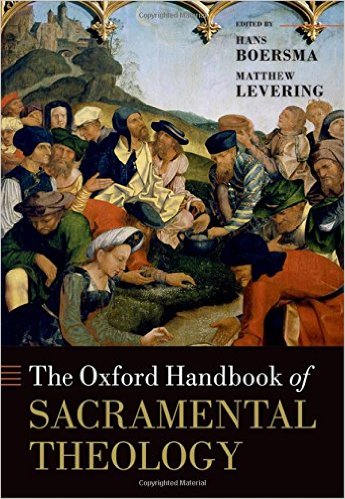
Oxford Handbook of Sacramental Theology

I’ve been reading through The Oxford Handbook of Sacramental Theology. Unfortunately, on account of the history of Christian doctrine the phrase “sacramental theology” can send shivers down the spine of a protestant evangelical. In light of this book’s actual content a more helpful description would be to call it a “theology of the sacraments”The book has a truly ecumenical line-up of authors contributing chapters (e.g., Anglican, Presbyterian, Orthodox, Evangelical, Methodist, Mennonite, and, yes, Roman Catholic). This means, inevitably, that sometimes chapters will have divergent views regarding the identity and nature of the sacraments (or ordinances if you prefer that term). However there is much to be gleaned from traditions different from our own. There is a veritable smorgasbord to feast on and it will stimulate and enrich your thinking about the sacraments. The book is organized into sections covering biblical, historical (patristic, medieval, and reformation through today), dogmatic, philosophical and theological categories.

Here is a few sample quotes that I found particularly thought-provoking:

“Strikingly, the fourth gospel omits the words of institution altogether, an omission which has attracted various explanations…perhaps a more promising explanation is that John intended the footwashing of John 13 to be understood as a parabolic reenactment of the Eucharist…On this theory, if the Eucharist commemorates and gives concrete expression to Jesus’s self-giving unto death, the fourth evangelist may well be interpreting sacramental participation as a call to selfless acts of humble service, exemplified iconically in Jesus’ washing of the disciples’ feet.” (Nicholas Perrin, 54)

“The symbolic action presents divine testimony” (Michael Allen, 288)

“In the eucharistic liturgy, the church journeys to the kingdom that is to come to enjoy the first fruits of the new creation. The church thereby discovers the kingdom is not some other, spiritual world, but this world of eating and drinking transfigured in resurrection life. By its participation in the Eucharist, the church becomes a sign of the coming kingdom, a real-life preview of what the world will be.” (Peter J. Leithart, 640)

I especially enjoyed the following chapters:

1. R.W.L. Moberly, “Sacramentality in the Old Testament”

3. Craig A. Evans and Jeremiah J. Johnston, “Intertestamental Background of the Christian Sacraments”

4. Nicholas Perrin, “Sacraments and Sacramentality in the New Testament”

5. Edith M. Humphrey, “Sacrifice and Sacrament: Sacramental Implications of the Death of Christ”

6. Richard Baukham, “Sacraments and the Gospel of John”

8. Luke Timothy Johnson, “Sacramentality and the Sacraments in Hebrews”

19. Michael Allen, “Sacraments in the Reformed and Anglican Reformation”

39. David Brown, “A Sacramental World: Why it Matters”

41. Peter J. Leithart, “Signs of the Eschatological Ekklesia: The Sacraments, The Church, and Eschatology”

But there were also excellent chapters by Scott Swain, Geoffrey Wainwright, Dennis Olson, David Lincicum, Everett Ferguson, Andrew Louth, George Hunsinger, Peter Galadza, Gordon Lathrop, and Catherine Pickstock.

The following is a list of key resources for a theology of the sacraments:

Bibliography for a Theology of the Sacraments

  • Beasley-Murray, G. R. Baptism in the New Testament. Eerdmans, 1973.
  • Boersma, Hans. Heavenly Participation: The Weaving of a Sacramental Tapestry. Eerdmans, 2011.
  • Brown, David. God and Grace of Body: Sacrament in Ordinary. Oxford University Press, 2011.
  • Byars, Ronald P. The Sacraments in Biblical Perspective: Interpretation: Resources for the Use of Scripture in the Church. Westminster John Knox Press, 2011.
  • Cavanaugh, William T. Torture and Eucharist: Theology, Politics, and the Body of Christ. Wiley-Blackwell, 1998.
  • Chan, Simon. Liturgical Theology: The Church as Worshiping Community. IVP Academic, 2006.
  • Danielou, Jean. Bible and the Liturgy. University of Notre Dame Press, 2002.
  • Davison, Andrew. Why Sacraments? Cascade Books, 2013.
  • Gerrish, B. A. Grace and Gratitude: The Eucharistic Theology of John Calvin. Wipf & Stock Pub, 2002.
  • Schmemann, Alexander. For the Life of the World: Sacraments and Orthodoxy. 2nd Revised & enlarged edition. St. Vladimir’s Seminary Press, 1973.
  • ———. The Eucharist: Sacrament of the Kingdom. Translated by Paul Kachur. St Vladimirs Seminary Pr, 2003.
  • Thompson, Philip E. Baptist Sacramentalism: Edited by Anthony R. Cross. Wipf & Stock Pub, 2007.
  • Torrance, James B. Worship, Community and the Triune God of Grace. IVP Academic, 1997.
  • Wainwright, Geoffrey. Eucharist and Eschatology. Order of Saint Luke Pub, 2002.
  • Wright, N. T. The Meal Jesus Gave Us. Westminster John Knox Press, 2015.
  • Zee, Leonard J. Vander. Christ, Baptism and the Lord’s Supper: Recovering the Sacraments for Evangelical Worship. IVP Academic, 2004.
  • Zizioulas, John D. The Eucharistic Communion and the World. Edited by Luke Ben Tallon. Bloomsbury T&T Clark, 2011.

Greek NT Rebound in Goatskin Leather

Tags

,


I recently sent my Large Print Greek New Testament (Nestle-Aland 28th edition) off to Leonard’s Book Restoration Station for a custom rebinding. Just got it back and I couldn’t be happier with the finished product.

Before sharing a some pics of Leonard’s excellent workmanship I want to say a few things about why I believe it is worth investing some money in a good quality copy of Holy Scripture. In other words, when someone says he or she doesn’t agree with spending lots of money on Bibles, how do I reply? Personally, I do not insist that everyone should have an expensive Bible. If someone is content with their $15 pocket NT I have no problems. Unfortunately, when people protest to spending lots of money on a Bible there is usually an implicit assumption that we shouldn’t spend lots of money on a Bible, sometimes with the suggestion that our money could be put to a better (more pious) use. Apart from the fact that this seems strangely similar to the complaint of Judas Iscariot when a woman poured expensive perfume on Jesus (John 12.3-8), the following are several reasons why I think a good quality Bible is worth a pretty penny:

  1. The Bible is the most important book we will ever own. Since we are willing to spend lots of money on other important items (e.g., computers, cars, clothes, food, etc.) why are shouldn’t we be willing to do the same for our Bibles?
  2. There is symbolic value in having your Bible bound in animal skin (leather of various kinds).
  3. Good quality books last much longer than inexpensive ones. This is especially important for Bibles because of the sentimental value they often have.
  4. We call the Bible “Holy Scripture”. The physical form of the book can reflect this fact by setting it apart from others on your shelf. The miserable state of some bibles communicates more that “I don’t care about this book” than “This book is Holy”.
  5. For those who struggle with spending time reading Scripture there is a good chance they will desire it more if they have a copy of the Bible that is enjoyable to hold in their hand and that they can be proud of. When I see the poor quality of some people’s Bibles I can’t blame them for not wanting to spend time with it.

These are just a few reasons I believe Holy Scripture is worth investing more than a few dollars in. I never claim that having an expensive Bible is more pious than a cheap Bible. I certainly do not make people feel guilty for owning an inexpensive Bible. But if you have the means, then a good quality Bible is a worthy investment. And if you are looking for a place to have your favorite Bible rebound, let me recommend Leonard’s Book Restoration Station (LBRS).

And now to the pics…

I started out with a hard cover like this:

Nestle_Aland_na28_1025485d39
And LBRS turned it into this:

I had some very particular requests and LBRS was happy to work with me on them.

My leather of choice was soft-tanned goatskin. This particular batch was tobacco colored and I asked for them to add antiquing to it.


The antiquing really gave it a masculine, slightly rustic, look. The brown ribbons complement the color of the leather nicely. I also wanted to have an extra ribbon so they put two in, one for the gospels and one for the epistles.


As you can see, the binding is tight but it still lays flat. None of that snap-close-when-you-let-go happening here.

The “Genuine Goatskin” stamp on the inside cover was slightly off balance. But that type of thing can be expected when you are dealing with custom work done by hand. I consider it a reminder that my bible was being handled by a real human, not an impersonal factory machine. Some might call it a flaw, I say it adds character.

I also wanted a full yapp edge. This is when the edge of the leather extends beyond the pages. One nice benefit of this, apart from the aesthetic appeal, is the protection it provides the pages when inside a backpack or messenger bag.


I also wanted the spine to have prominent raised wrap-around ribs. I really like the distonguished look this gives it.


Here you can see how the ribs wrap around the side of the spine. Notice also how the antiquing effect highlights the natural grain pattern of the leather.


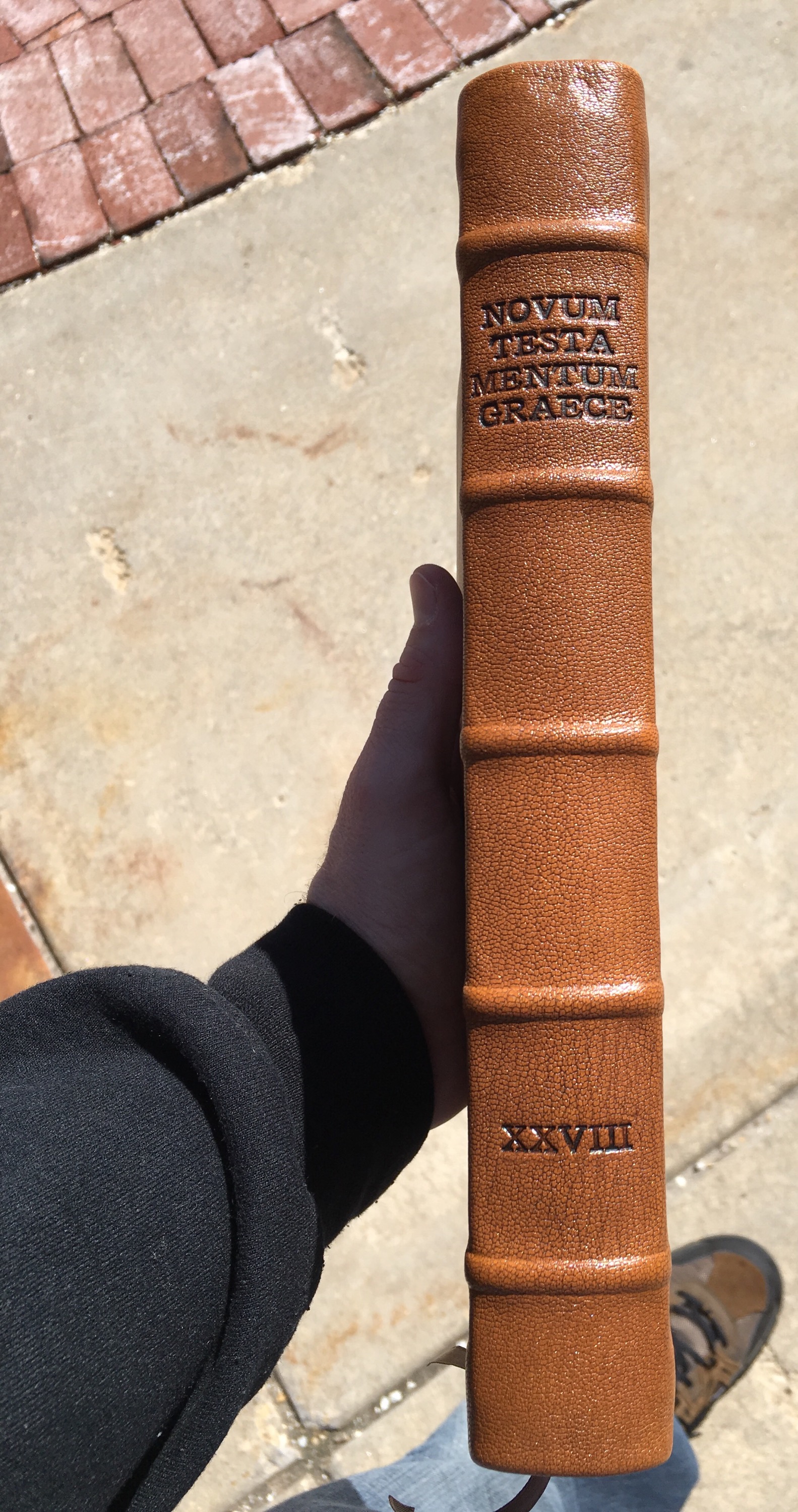
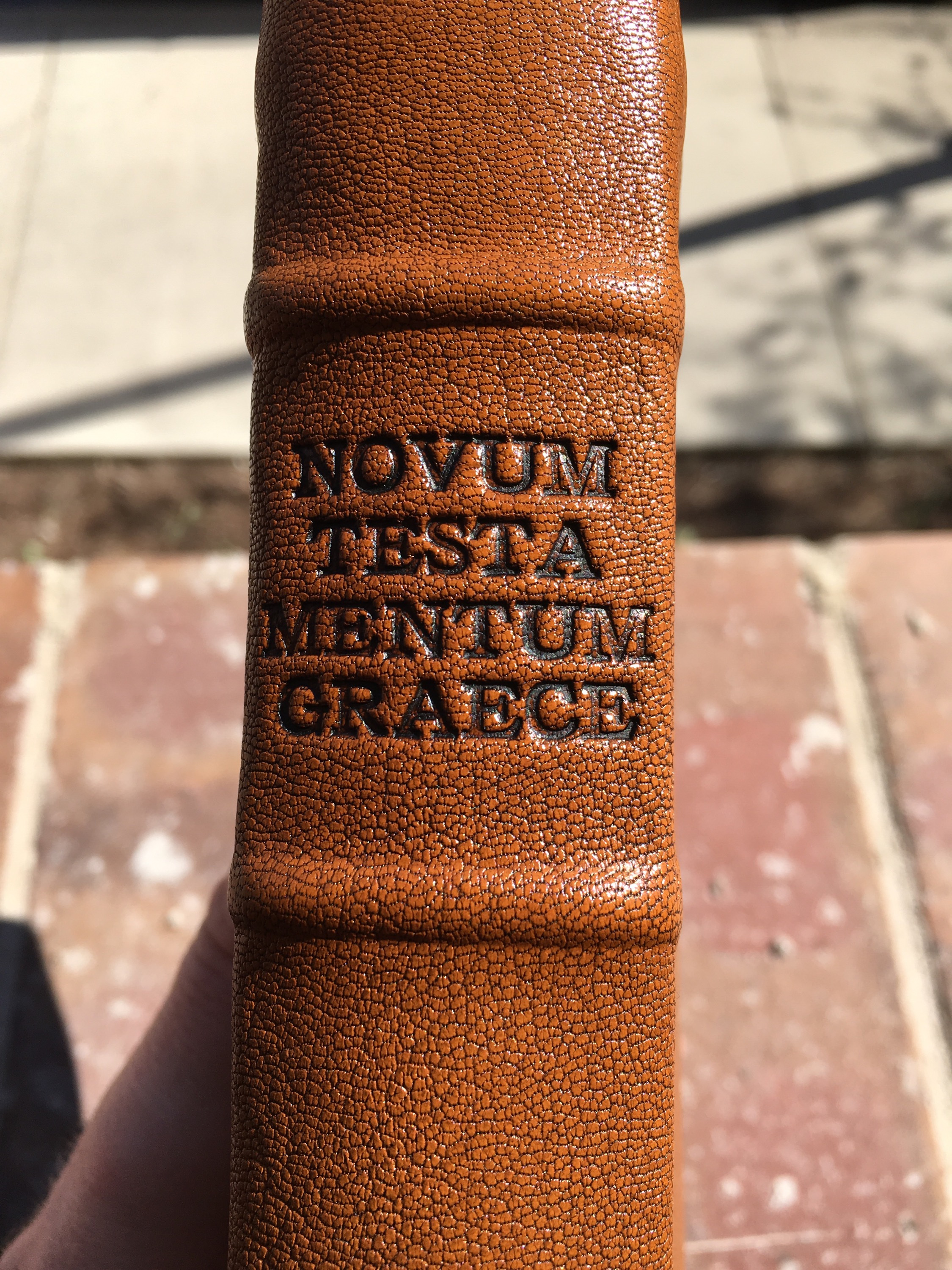
Here is a side view. I asked for the title, “Novum Testamentum Graece” to be hand-tooled into the spine, along with the Roman numeral “XXVIII” (28th edition text).


They also hand rubbed the antiquing into the text on the spine.


This really gave the text a bold look. Again the antiquing came out great with this color of leather.


And finally, here is a shot showing the relative size compared to a few other Bibles.

From the top: KJV pocket size snap cover, ESV Cambridge Clarion, NIV Allan, NA28 Large Print from LBRS.

They are all goatskin. The KJV is goatskin suede.


Notice the varying length of the cover edges. The ESV Cambridge Clarion does not have the yapp edge, the NIV does.

In sum, Leonard’s Book Restoration has done an excellent job on this project and I heartily recommend them. I can’t wait to spend time reading and studying Scripture in this new edition.

Longenecker’s Commentary on Romans

Tags

, , ,

longenecker romans

Richard N. Longenecker recently released his new commentary on Romans in the NIGTC series. I got my copy in the mail not too long ago and have been slowly working through it (it’s a mammoth 1,086 pages of commentary!). Below I list some of my own observations by way of a quick critical review.

There is virtual consensus among Pauline scholars that Romans is structured with four clearly distinguishable sections: chs. 1-4, chs. 5-8, chs. 9-11, chs. 12-16. Further, commentators will typically emphasize one particular section as being the heart of Romans. Sometimes, but not always, the emphasis given to a particular section is correlate with that commentator’s theological persuasions; e.g., those who understand justification in juridical terms will focus on Rom 1-4, those who focus more on participationist categories will look to Rom 5-8, etc. While Longenecker certainly doesn’t ignore the juridical category, he does understand chs. 5-8 to be the essence, and primary thrust, of Romans. This preference is reflected in statements like the following (pg. 566):

What he appears to be doing in 5:9-11 is attempting to convince his addressees that there is much more to to the Christian gospel than simply the forensic doctrine of justification ‘by the blood of Christ'(εν τω αιματι αυτου) or ‘through the death of God’s Son’ (δια του θανατου του υιου αυτου) — as important as that emphasis is in Christian proclamation. What also needs to be considered and experienced is what Christ has effected on behalf of those who respond to him by faith in terms of the ‘personal,’ ‘relational,’ and ‘participatory’ theme of reconciliation. 

Longenecker’s primary dialogue partners are C.K. Barret, C.E.B Cranfield, James D. G. Dunn, Joseph A. Fitzmyer, Robert Jewett, Ernst Käsemann, Douglas J. Moo, Arthur C. Headlam, and William Sanday. It is true that, even for a commentary over a thousand pages, one has to be selective about who to engage with while interpreting particular texts. Nevertheless, I was quite surprised that N.T. Wright’s commentary on Romans (NIB series vol. 10) did not even make it into the bibliography! It would’ve been interesting to see more dialogue between the two. 

On the other hand, Longenecker shows an impressive familiarity with ancient sources. He regularly interacts with writings from the Pseudepigrapha, Dead Sea Scrolls, early Christian writings, as well as Classical / Hellenistic sources. His textual criticism is thorough, often giving several pages of discussion to variants and the respective mss. involved. It appears that he relies primarily on Bruce Metzger’s Textual Commentary on the Greek New Testament for text critical dialogue, though Longenecker is by no means dependent on Metzger for his conclusions (e.g., Rom 5:1, Longnecker reads the subjunctive εχωμεν as original contra. Metzger who takes Paul to have dictated εχομεν for which Tertius wrote εχωμεν). 

Unlike some commentaries which seem to comment more on previous commentaries, Longenecker strikes an even balance between engagement with previous interpreters and the text of Romans itself. (This despite my personal judgement that engagement with some important contemporary interpreters were often left out of his discussions at key points)

His sections throughout on Biblical Theology and Contextualization for Today were sometimes helpful and sometimes confusing. It may have proved helpful to have an explanation on how he intended these sections to function within the structure of his commentary. At times they were combined into a single section under one heading. 

Now some grist for the mill…

 Regarding the background of ευαγγελιον in 1:1, Longenecker, following Käsemann and Stuhlmacher, rejects any counterimperial resonances in the word (see pgs. 58-61). 

Contrast N.T. Wright who, while not denying the primary significance of the OT for understanding the word, sees a counterimperial resonance as unavoidable for believers living in the heart of the Roman Empire: 

In Paul’s Jewish world, the word looked back to Isa 40:9 and 52:7, where a messenger was to bring to Jerusalem the good news of Babylon’s defeat, the end of Israel’s exile, and the personal return of YHWH to Zion. In the pagan world Paul addressed, the same Greek word referred to the announcement of the accession or the birthday of a ruler or emperor. Here already we find Paul at the interface of his two worlds. His message about Jesus was both the fulfillment of prophecy, as v. 2 indicates, and the announcement of one whose rule posed a challenge to all other rulers. 

[Wright, Romans, 415-416]

I can’t imagine Paul being ignorant about the possibility of his readers (or listeners) in Rome thinking of both Isaiah’s ευαγγελιον and also Caesar’s ευαγγελιον. Therefore, in this instance I find Wright’s position more appealing. 

Longenecker has the following excurses (although they are unhelpfully absent from the Table of Contents and Index): 

  • “The Righteousness of God” and “Righteousness” in Paul (168-176)

  • Three exegetical and thematic matters in Rom 3:25a that are of particular importance (though also frequently disputed) and therefore deserving of special consideration (425-432)

  • “The law,” “Works of the law,” and “The New Prespective” (362-370)

  • Paul’s message of reconciliation (566-570)  

  • Paul’s use of “In Christ Jesus” and its Cognates (686-694)

  • On the terms for “Remnant” in the OT Scriptures (MT and LXX), as well as the use of “Remnant” in the Rabbinic tractates of formative Judaism and the Jewish nonconformist writings of the first centuries B.C. (803-810) 

In sum, Longenecker has given us an excellent commentary, though not without some quibbles. He is an accomplished scholar who has given us much to think about for Romans. This is not just a rehearsal of previous positions on old debates. Longenecker often has creative new solutions of his own, even if not always convincing. Even in areas where I found myself disagreeing with his conclusions he always gives excellent material to work with (or to disagree with). He is a clear writer. This commentary will certainly be one of the first Romans commentaries I pull of the shelf when in need. 

Paul and Second Temple Judaism

Tags

, , , , ,

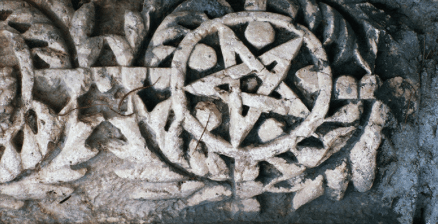
Second Temple Jewish Star

James H. Charlesworth has crafted 12 questions to guide his review of N.T. Wright’s Paul and the Faithfulness of God. The stated goal of the questions is to allow him “to classify the best approach to the very complex world of Second Temple Judaism in ancient Palestine and in the Diaspora, Paul’s relation to it, and Wright’s presentation of each.”¹

So here is my idea for how someone could use Charlesworth’s questions to write a book (publishers take note). The questions (or some modification of them) would serve as a great tool for comparing various contemporary presentations of Paul. Charlesworth himself should contribute the Foreword or Introduction so as to give him the proper credit for the questions. I propose that the following works on Paul could profitably be analyzed on the basis of Charlesworth’s questions:

  • F.F. BrucePaul Apostle of the Heart Set Free. Paternoster Press, 1977.
  • James D. G. DunnThe Theology of the Apostle Paul. Eerdmans, 1998.
  • Thomas R. SchreinerPaul, Apostle of God’s Glory in Christ: A Pauline Theology. InterVarsity Press, 2001.
  • Michael J. GormanApostle of the Crucified Lord: A Theological Introduction to Paul and His Letters. Eerdmans, 2004.
  • Anthony C. ThiseltonThe Living Paul: An Introduction to the Apostle’s Life and Thought. InterVarsity Press, 2009.
  • N.T. WrightPaul and the Faithfulness of God. Fortress Press, 2013.
  • John M.G. BarclayPaul and the Gift. Eerdmans, 2015.
  • E.P. SandersPaul: The Apostle’s Life, Letters, and Thought. Fortress Press, 2015.

So what are Charlesworth’s questions? (below I have replaced “Wright” with “our author” to make them applicable to other works)

  1. I am certain that [our author] would assiduously avoid any semblance of Anti-Judaism (Anti-Semitism), but would he agree with the stellar group of Pauline specialists who convened in Rome in 2014 to demonstrate how Paul now must be understood within Second Temple Judaism?
  2. Paul states that he is proud to be a Jew and a Pharisee, so does [our author] err and cast Paul as a “Christian,” sociological and theological category which is anachronistic to many experts for the period before 70 CE?
  3. Does [our author] avoid such misleading dichotomies as “Hellenistic Judaism” versus “Palestinian Judaism” and “Orthodox Judaism” versus “Sectarian Judaism”?
  4. In examining pre-70 CE sociological and theological contexts, does [our author] choose to use terms that are now relegated to the dust bin, according to most scholars, such as “canonical,” “canon,” “extra-canonical,” as well as “church,” “orthodoxy,” and “heresy”?
  5. Does [our author] appreciate how significantly the concepts and terms in the Dead Sea Scrolls have revolutionized scholars’ approach to Second Temple Judaism, Christian Origins, and Paul? And specifically, how dies he use the evidence of “works of law” now found in Second Temple  Judaism to clarify the same term in Galatians?
  6. If [our author] sees a unity within Second Temple Judaism, what is it and how does he obtain that insight; and if he sees only diversity, how does he explain the colossal change in 66 CE?
  7. Does [our author] appreciate the many groups and sects within Second Temple Judaism and does he do justice to the Samaritans?
  8. How does [our author] treat the “sacred writings” in the Old Testament Pseudepigrapha (that is, does he find God’s Word in any of them, as did the early Jews and “Christians”?); and does he engage the authors who have claimed Paul quoted from or at least knew one or more these documents?
  9. Does [our author] perceive that Paul’s main inheritance from Judaism is apocalyptic eschatology?
  10. Would [our author] agree with those that conclude Paul broke from Jesus by rejecting the purity laws, dietary restrictions, circumcision, and taking the “good news” to Gentiles?
  11. Has [our author] found “the heart of Paul’s theology” or has he allowed Paul to be as contradictory as he seems to be in his authentic letters?
  12. Where do we find Paul’s genius and creativity and how do we know that when so many ideas we all once concluded had originated with Paul are now being discovered in early Jewish texts?

Some of the questions may need to be reformulated. Charlesworth’s own presuppositions are apparent in more than one. Nevertheless, they do serve as launch point for further discussion of how different authors handle the issues concerned. I think it would be quite revealing to consider how each of the above mentioned works on Paul deals with each of these topics. It will go a long way toward demonstrating the relative strengths and weaknesses of each work. Further, it would potentially uncover additional areas where more work is needed.

So…will someone please take this idea and run with it?


¹ See “Wright’s Paradigm of Early Jewish Thought: Avoidance of Anachronisms?” in God and the Faithfulness of Paul (Mohr Siebeck 2016) edited by Christoph Heilig, J. Thomas Hewitt, and Michael F. Bird, 207-234, 207.

Recent Articles in JSNT

Tags

, ,

jsnt

Journal for the Study of the New Testament has some good articles just out last month. Two in particular are worth mentioning:

What to Expect when you’re Expecting: Maternity, Salvation History, and the “Apocalyptic Paul” by J.P. Davies, JSNT 38:3 (2016) 301-315.

Here is the abstract:

This article argues, on the basis of Jewish and Christian apocalypses, that ‘apocalyptic’ in Paul should not be understood as antithetical to ‘salvation history’. It focuses on one of Paul’s key metaphors, childbirth, which has been identified as an image intrinsically connected to Paul’s apocalyptic eschatology. It will first offer a brief survey of the way the image of childbirth has been deployed in recent ‘apocalyptic’ interpretations of Paul (notably the work of Beverly Gaventa) in support of a ‘punctiliar-invasive’ theology of history over against a ‘linear-progressive’ view. It will then examine some of the evidence from the apocalyptic literature where childbirth is used as an eschatological metaphor, particularly in the book of Revelation. It will argue that an understanding of the logic of this metaphor in Second Temple Jewish and early Christian apocalyptic thought raises questions about the eschatological dichotomy at the heart of the contemporary ‘apocalyptic Paul’ movement.


‘Christ-Faith’ as an Eschatological Event (Galatians 3.23-26): A ‘Third View’ on Πιστις Χριστου by Benjamin Schliesser, JSNT 38:3 (2016) 277-300.

Here is the abstract:

The meaning of πιστις Χριστου in Paul (Gal. 2.16, 20; 3.22; Rom. 3.22, 26; Phil. 3.9) continues to be the subject of controversial debate in Pauline scholarship. Should the genitive construction be understood objectively as ‘faith in Christ’ or subjectively as ‘the faith(fulness) of Christ’? The prevalent either/or character of the discussion is increasingly proving to be an impediment to finding a solution to this issue. A minority view, the so-called ‘third view’, seeks to move beyond the subjective-objective dichotomy by accounting for the intrinsic complexity of the Greek genitive and pointing to the event-character of in πιστις Paul. The primary reference text for this ‘third-view’ is Gal. 3. 23–26, which exhibits an altogether remarkable language of faith and envisages πιστις as ‘coming’ (ερχεσθαι) and as ‘being revealed’ (αποκαλυπτεσθαι). This article reviews the exegetical status quaestionis and argues that Paul does not regard πιστις Χριστου as an individual disposition or character (either Christ’s or that of the believer), but rather as an eschatological event. The aim is not to offer a comprehensive analysis of the verses in question, but to advance exegetical and theological support for the ‘third view’ and to point to its considerable explanatory power in our effort for a more nuanced appreciation of Paul’s language of faith.

(click here for JSNT webpage)

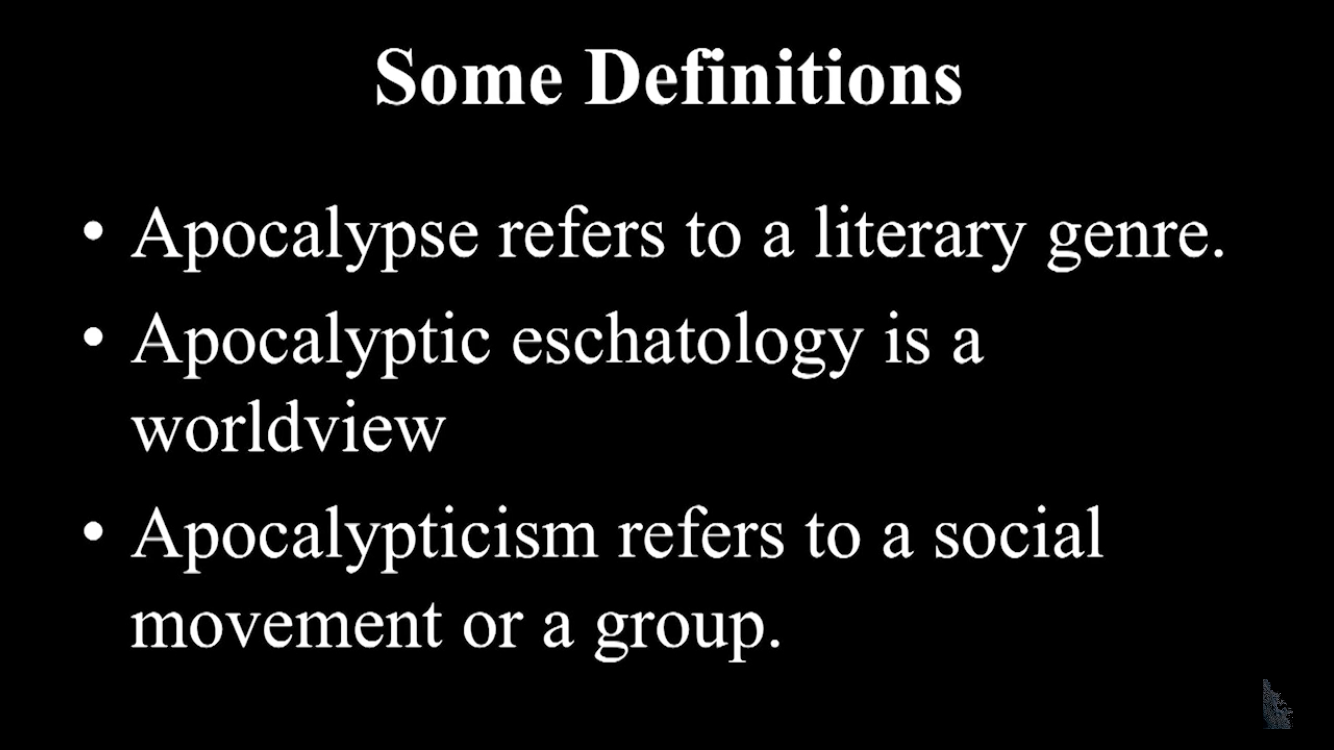
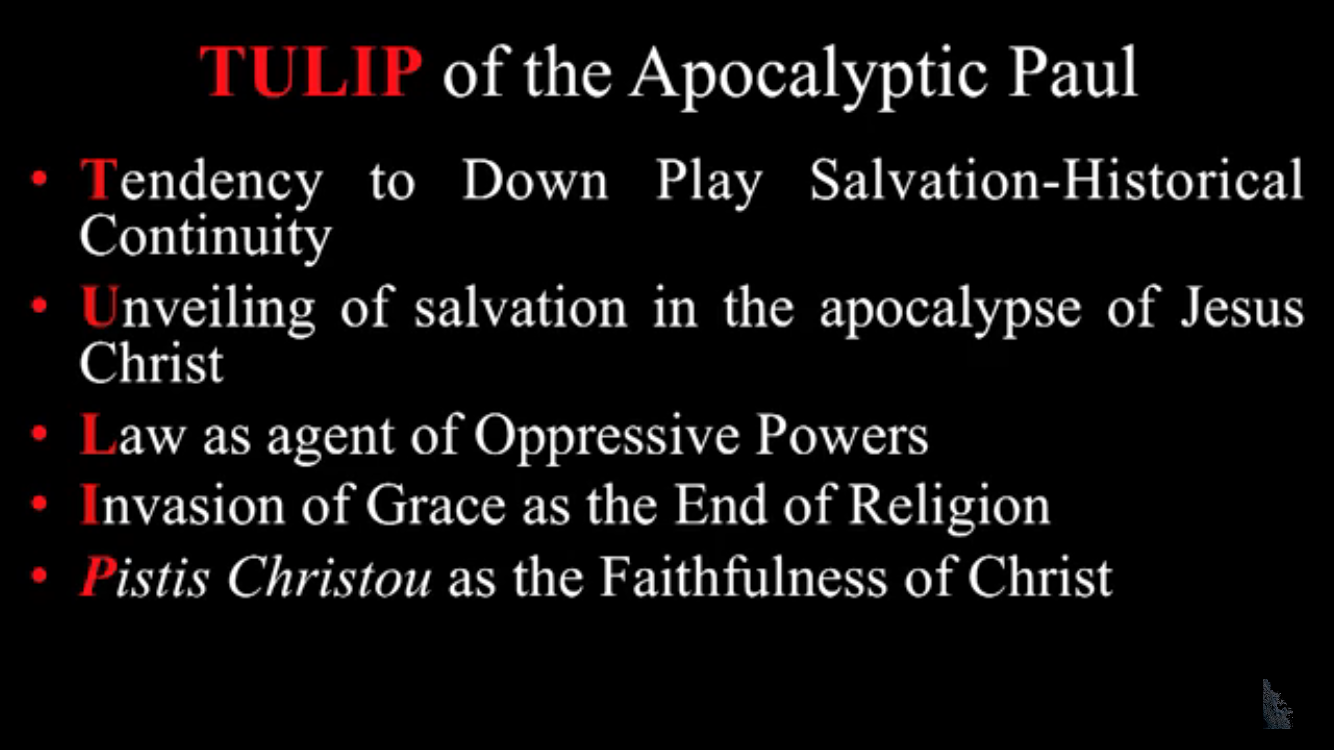
Michael F. Bird Gives a Talk on the Apocalyptic Paul 

Bird delivered the most recent lecture over at The Lanier Theological Library. It’s a very helpful talk on the apocalyptic Paul (particularly as developed by J. L. Martyn). He provides an excellent overview of this whole debate and, as always, peppers it with his Aussie humor. 

Click here: YouTube video lecture

Here are a couple slides from the lecture to peak your interest: 


Peter Stuhlmacher on N.T. Wright’s Method

Tags

, , , ,

Senior theologian Peter Stuhlmacher, from University of Tübingen, has contributed a chapter entitled “N.T. Wrights’s Understanding of Justification and Redemption” in God and the Faithfulness of Paul (Mohr Siebeck 2016). He has some important criticisms as well as a few affirmations.

Here is a quote from Stuhlmacher regarding Wright’s exegetical method (page 371):

Rather than beginning with the historical origin of the individual texts and their statements, Wright prefers to work with entire passages, biblical contexts, and macro perspectives (PFG 965). He immerses himself into the Pauline world of ideas, Paul’s uses of Scripture together with the expectations  of salvation, reconstructs these and integrates Paul’s writings into that reconstruction. This constructive procedure uncovers some new matters that previously remained obscure. But it also gives Wright’s presentation a largely hypothetical character.